Tiles are still the default finish for Singapore kitchens, bathrooms, balconies and service yards, and many resale owners use them throughout the home. They are hard wearing, water resistant and cool underfoot, but they are also one of the most permanent decisions in a renovation: changing them later means hacking, noise, a permit in HDB flats and new waterproofing in wet areas.
The words used in showrooms can be confusing. "Homogeneous", "porcelain", "full-body" and "glazed" describe different things: what the tile is made of, how dense it is, and whether the colour runs through the body or sits on the surface. Size, surface finish and slip resistance matter as much as the look.
This guide covers every tile type Singapore homeowners realistically choose from, then explains finishes and anti-slip ratings, sizes, grout, overlay versus hacking, and the HDB rules for tiling, including the 3-year restriction on bathroom finishes in new flats. For non-tile floors such as vinyl and timber, see our flooring guide.
Tiles options at a glance
| Option | Cost | Durability | Upkeep | Best for |
|---|---|---|---|---|
| Homogeneous (full-body porcelain) tiles | Mid-range | excellent | low | Floors in kitchens, bathrooms, service yards and high-traffic living areas |
| Glazed porcelain tiles | Mid-range | good | low | Marble-look, wood-look and cement-look floors and walls |
| Ceramic tiles | Budget | moderate | low | Bathroom and kitchen walls, backsplashes, subway and kit-kat feature walls |
| Large-format porcelain tiles and slabs | Upper | excellent | low | Open living and dining areas, feature walls and condo homes |
| Mosaic tiles | Upper | good | medium | Shower floors, wall niches, backsplashes and feature panels |
| Natural stone tiles (marble, granite, travertine) | Premium | good | high | Dry living areas and feature walls in condos and landed homes |
| Terrazzo tiles | Upper | excellent | medium | Feature floors, bathroom walls and retro or contemporary kitchens |
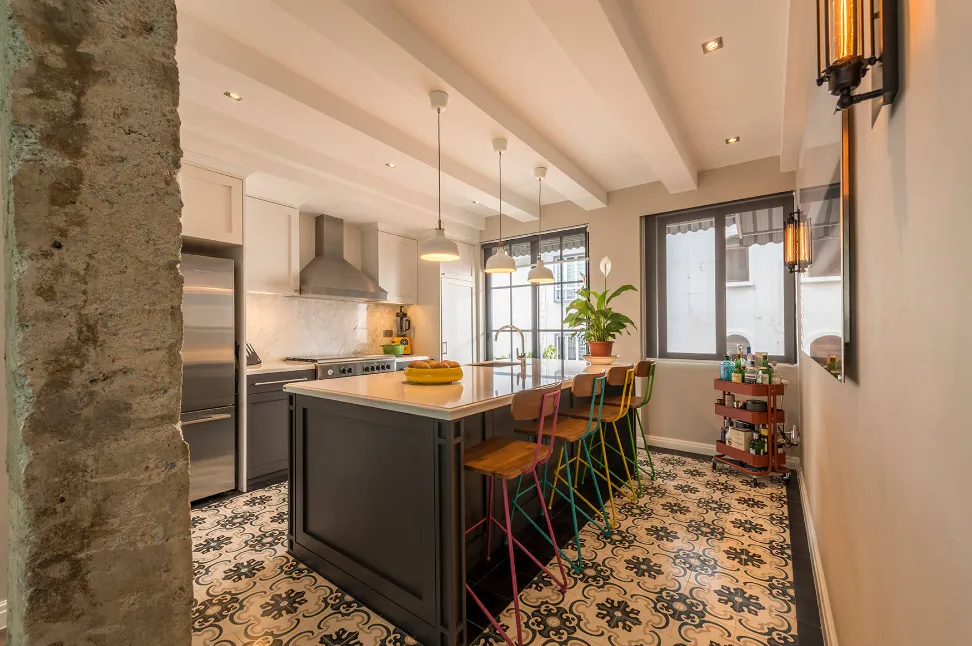
| Patterned and cement-look tiles (including Peranakan styles) | Mid-range | good | medium | Kitchen backsplashes, entrance areas, bathroom feature walls and balconies |
| Overlay tiles (thin tiles over existing finishes) | Budget | good | low | Refreshing sound existing tiles in kitchens, service yards and walls |
Cost is relative within tiles ($ budget to $$$$ premium). Actual prices depend on brand, size and workmanship, so compare itemised quotes.
Homogeneous (full-body porcelain) tiles
- Mid-range Mid-range
- Durability: excellent
- Upkeep: low
Dense porcelain tiles whose colour and material run through the whole body, so chips are less visible. The workhorse floor tile in Singapore kitchens, bathrooms and living areas.
Best for: Floors in kitchens, bathrooms, service yards and high-traffic living areas
Pros
- Very hard and low in water absorption
- Chips and wear show less because the colour runs through
- Suits both floors and walls
- Available in matte, polished and anti-slip finishes
Cons
- Plainer designs than glazed tiles (mostly solid, speckled or salt-and-pepper)
- Polished versions are slippery when wet
- Hard to cut and drill, so labour can cost more
- Heavy, especially in larger sizes
Porcelain is generally defined by very low water absorption, at or below 0.5% under the ISO tile classification, which is what makes it suitable for wet areas. Houzz Singapore describes homogeneous tiles as among the best floor tiles for their resilience, suitable for both floors and walls.
Note that some sellers use "homogeneous" loosely for any porcelain tile. Ask whether the tile is genuinely full-body, and check the technical data sheet for water absorption and slip rating.
Stacked Homes notes homogeneous tiles are common in Singapore and recommends rough, matte homogeneous tiles for toilets and bathrooms. Qanvast estimates tile material at about $5 to $35 psf and installation at about $4 to $6 psf (2025), excluding hacking.
Glazed porcelain tiles
- Mid-range Mid-range
- Durability: good
- Upkeep: low
Porcelain tiles with a printed design under a glass-like glaze. They can convincingly mimic marble, wood, cement or stone, and are the most popular way to get a premium look on a mid-range budget.
Best for: Marble-look, wood-look and cement-look floors and walls
Pros
- Realistic marble, timber, stone and concrete designs
- Same dense, low-absorption porcelain body as full-body tiles
- Easy to clean and stain resistant
- Wide choice of matte, satin and polished finishes
Cons
- Chips show the different-coloured body underneath
- Glossy glazes can scratch in busy areas
- Repeated print patterns can look artificial on large floors
- High-gloss versions are slippery when wet
Houzz Singapore explains that glazed porcelain has its design printed on the surface and coated with a layer of liquid glass, so scratches and cracks show more easily, and suggests it mainly for walls. In practice, many glazed porcelain tiles are rated for floors; check the supplier's data for floor suitability and abrasion resistance.
Qanvast notes porcelain can be glazed to mimic marble, wood or cement. When choosing marble or wood looks, ask how many different faces (print variations) the series has so that the pattern does not obviously repeat. Lay out tiles before fixing to mix them well.
Matte and lightly textured glazed tiles are a practical middle ground for kitchens: Qanvast recommends matte or lightly textured floor tiles there because they resist slipping.
Ceramic tiles
- Budget Budget
- Durability: moderate
- Upkeep: low
Clay tiles fired at lower temperatures than porcelain and finished with a glaze. More porous and softer, so they are mainly used on walls, backsplashes and low-traffic areas.
Best for: Bathroom and kitchen walls, backsplashes, subway and kit-kat feature walls
Pros
- Lowest-cost tile option
- Lighter and easier to cut than porcelain
- Huge range of colours, glazes and shapes, including subway and kit-kat
- Easy to clean with neutral detergent
Cons
- More porous and less dense than porcelain
- Less suited to high-traffic floors
- Chips reveal the clay body
- Glossy wall glazes can show water spots
Qanvast describes ceramic as more porous and less dense than porcelain, which makes it more affordable but less suited for high foot traffic; it suggests ceramic for feature walls and dry bathroom areas. Houzz Singapore estimates most ceramic tiles at about $2.80 to $14 psf (an older estimate) and advises cleaning with a neutral, non-acidic detergent.
Popular wall formats include subway tiles laid in a staggered brick bond, small vertical kit-kat tiles, and fish scale or mermaid shapes. These have many grout lines, so consider epoxy grout in splash zones to reduce staining.
In HDB flats, laying wall tiles over existing wall finishes with adhesive needs no permit if the new finish is no thicker than 13mm and there is no third layer.
Large-format porcelain tiles and slabs
- Upper Upper
- Durability: excellent
- Upkeep: low
Porcelain tiles in large sizes, from 60 x 120cm up to slab formats, used to reduce grout lines on floors and feature walls. They give a near-seamless, high-end look.
Best for: Open living and dining areas, feature walls and condo homes
Pros
- Few grout lines, so rooms look larger and cleaner
- Fewer joints to clean and stain
- Book-matched marble looks are possible on feature walls
- Same durability as standard porcelain
Cons
- Needs a very flat base, skilled tilers and careful handling
- More wastage and breakage risk when cutting and lifting
- Harder to form floor falls to drains in small bathrooms
- Moving large pieces through HDB lifts and corridors can be difficult
Houzz Singapore notes large floor tiles look more seamless with fewer grout lines but can create more wastage, and recommends 30 x 30cm or 30 x 60cm tiles for HDB bathrooms because smaller tiles make it easier to form the slope to the floor drain.
For living areas, 60 x 60cm and 60 x 120cm are common, with larger slabs mainly in condos and landed homes. Ask your tiler about the flatness tolerance of the base, levelling clips, whether the tiles will be fully bedded to avoid hollowness, and how pieces will be delivered to your unit.
Remember HDB's 50mm limit on total floor finishes and screed when replacing floors, and allow extra tiles for breakage.
Mosaic tiles
- Upper Upper
- Durability: good
- Upkeep: medium
Small tiles of glass, porcelain or stone, usually supplied on mesh-backed sheets. Used for shower floors, niches, backsplashes and decorative feature panels.
Best for: Shower floors, wall niches, backsplashes and feature panels
Pros
- Follows slopes and curves easily, good for shower floors
- Many grout lines give extra grip underfoot
- Strong decorative impact in small areas
- Glass and porcelain mosaics resist water well
Cons
- Many grout lines to clean and maintain
- Labour-intensive to lay neatly, so cost per square foot is higher
- Sheets can show grid lines if laid carelessly
- Can look busy if used over large areas
Mosaic sheets are useful in shower areas because the small pieces can follow the floor fall to the drain. Their many joints mean grout choice matters: Qanvast notes cement-based grout is not waterproof and needs periodic touch-ups, while epoxy grout is stain resistant and waterproof but costs more.
Use mosaics as an accent (a niche, a shower floor, a backsplash strip) rather than everywhere, especially in small HDB bathrooms. Ask the tiler to lay sheets so the joints between sheets match the joints within them. For a Peranakan or resort look, see the Peranakan and Resort concepts.
Natural stone tiles (marble, granite, travertine)
- Premium Premium
- Durability: good
- Upkeep: high
Tiles cut from quarried stone. Each piece is unique, but most stones are porous and need sealing, and polished stone is slippery when wet.
Best for: Dry living areas and feature walls in condos and landed homes
Pros
- Genuine natural variation and depth
- Can be re-honed and re-polished
- Adds a premium feel
- Granite is very hard wearing
Cons
- Porous, so it can stain, and marble etches with acids
- Needs sealing and careful cleaning
- Polished stone is slippery in wet areas
- Expensive to buy and lay
Houzz Singapore notes natural stones such as granite, marble, travertine and onyx are often porous and can stain, so sealing is advised. It suggests polished stone for dry zones, and non-polished, anti-slip treated stone where it must be used in wet areas. It estimated marble at about $21 to $150 psf (an older estimate) and warns against vinegar, lemon juice, acidic cleaners and bleach.
Ask the supplier which sealer to use and how often, whether the tiles are calibrated to a consistent thickness, and to see the actual batch rather than a sample. Marble-look porcelain is a lower-maintenance alternative for bathrooms and kitchens.
Terrazzo tiles
- Upper Upper
- Durability: excellent
- Upkeep: medium
Factory-made tiles with stone or glass chips in a cement or resin base, or porcelain printed to look like terrazzo. A popular retro and contemporary accent.
Best for: Feature floors, bathroom walls and retro or contemporary kitchens
Pros
- Distinctive speckled look
- Real terrazzo is very hard wearing
- Easier to lay and replace than poured terrazzo
- Terrazzo-look porcelain is low maintenance
Cons
- Real cement-based terrazzo is porous and needs sealing
- Busy patterns can overwhelm small rooms
- Real terrazzo tiles are heavy and pricier than printed versions
- Polished surfaces are slippery when wet
Qanvast describes terrazzo as marble, quartz, granite or glass chips set in a cement or resin base and polished. Ask whether a "terrazzo" tile is real terrazzo or printed porcelain: the porcelain version is lighter, less porous and cheaper, while the real thing can be re-polished.
Choose a matte or honed finish for bathroom floors, and keep large-chip patterns for bigger spaces or small accent areas. Terrazzo suits the Retro and Modern concepts.
Patterned and cement-look tiles (including Peranakan styles)
- Mid-range Mid-range
- Durability: good
- Upkeep: medium
Decorative tiles with printed or inlaid patterns, from Peranakan-inspired motifs to encaustic-style geometrics. Mostly used as accents on floors, backsplashes and entrance areas.
Best for: Kitchen backsplashes, entrance areas, bathroom feature walls and balconies
Pros
- Strong character in a small area
- Printed porcelain versions are durable and easy to clean
- Suits Peranakan, retro, bohemian and colonial styles
- Can define zones in an open-plan flat
Cons
- Real cement (encaustic) tiles are porous and need sealing
- Can date faster than plain tiles
- Patterns need careful setting out to align at edges
- Large patterned areas can make small rooms feel busy
Many patterned tiles sold today are glazed porcelain or ceramic with the pattern printed on, which keeps them easy to clean. True cement or encaustic tiles have the pattern made from coloured cement and are more porous, so ask about sealing and cleaning before using them in kitchens or bathrooms.
Plan the layout on a drawing before ordering, so the pattern is centred and cut pieces fall at less visible edges. A strip of patterned tiles in the entrance or a single backsplash often gives more impact than a whole floor. See the Peranakan, Bohemian and British Colonial concepts.
Overlay tiles (thin tiles over existing finishes)
- Budget Budget
- Durability: good
- Upkeep: low
New tiles laid with adhesive directly over existing tiles, without hacking. A quicker, quieter way to refresh a floor or wall, within strict HDB thickness limits.
Best for: Refreshing sound existing tiles in kitchens, service yards and walls
Pros
- No hacking, so less noise, dust and debris
- Faster than full re-tiling
- No permit needed in HDB flats within the stated limits
- Lets you keep tiles in areas where vinyl is unsuitable
Cons
- Only works over one sound existing layer
- Raises floor level, affecting doors, drains and adjacent rooms
- Hollow or loose tiles underneath will cause problems later
- Cannot be used inside the household shelter
SmartCalculator estimates overlay tiles at about $3 to $9 psf installed (2026). HDB's rules for laying floor finishes over existing finishes using adhesive only: there must be only one existing layer (including screed), the new finish including adhesive must not exceed 13mm, the floor trap must not be tampered with, and the work must not cause backflow or lateral seepage into bedrooms. For walls, the overlay must not exceed 13mm and a third layer is not allowed.
The household shelter is different: HDB does not allow adhesive-laid floor tiles or a second layer of tiles there. Home & Decor quotes a tile supplier suggesting tile overlays mainly for smaller areas, with vinyl or laminate for larger rooms.
Glazed or full-body?
Full-body (homogeneous) tiles have the same colour throughout, so chips and wear are less visible; they suit busy floors. Glazed tiles carry the design on the surface, allowing realistic marble, wood and cement looks. For most homes, glazed porcelain on walls and feature floors, and full-body or matte glazed porcelain on kitchen and bathroom floors, is a sensible split.
Finishes and slip resistance
- Polished: shiny and reflective, easy to wipe, but slippery when wet. Best for dry living areas.
- Matte or honed: softer look, hides water spots and gives better grip. Qanvast recommends matte or lightly textured tiles for kitchen floors.
- Anti-slip (textured): for bathroom and shower floors, balconies and service yards. Qanvast suggests tiles rated R10 to R12 for bathroom floors, especially shower areas. Rougher surfaces grip better but hold dirt, so do not over-specify.
Ask for the slip rating and water absorption on the tile's technical data sheet, not just the showroom label.
Sizes
- Small (mosaic, 10 x 10cm and below): shower floors and niches.
- 30 x 30cm and 30 x 60cm: Houzz Singapore recommends these for HDB bathrooms because they make floor falls to the drain easier.
- 60 x 60cm and 60 x 120cm: living, dining and kitchen floors.
- Slabs: feature walls and large open areas, needing specialist tilers.
HDB rules for tiling
From HDB's building works guidelines:
- Replacing floor finishes (ceramic, homogeneous, terrazzo, marble, other tiles) needs a permit. Total thickness of finishes and screed must not exceed 50mm, and pre-packed screed must be used.
- Bathrooms and toilets: pre-packed waterproofing screed and a waterproofing membrane are required before new floor finishes, with the membrane turned up at least 150mm against walls, kerbs and pipes, plus a UPVC floor trap grating with long collar. Kitchens and open balconies need pre-packed waterproofing screed, with membrane around the sanitary stacks.
- 3-year restriction: newly built flats cannot have bathroom and toilet wall and floor finishes removed in the first 3 years from the block's completion date. After that, replacement needs a permit.
- Wall tiles: replacing internal wall finishes up to ceiling level needs a permit, with total thickness including plaster no more than 25mm. Overlaying with adhesive needs no permit if the new layer is no more than 13mm and there is no third layer.
- Household shelter: floor tiles must be bonded with wet cement mortar; adhesive and a second layer are not allowed, and wall tiles cannot be laid on its internal faces.
Your HDB-registered contractor submits any permit. See our HDB renovation permit guide. HDB also notes that its ceiling leak warranty ends if floor tiles are changed or waterproofing is tampered with, a point covered in our BTO key collection checklist.
Grout and workmanship
- Cement grout is the standard; it is not waterproof and needs occasional touch-ups.
- Epoxy grout resists stains and water and suits showers and backsplashes, at a higher cost.
- Ask whether tiles will be fully bedded to reduce hollowness. BCA's Good Industry Practices guide on ceramic tiling covers preparation, installation, protection and common defects, and HDB notes tiles can pop from thermal movement and water absorption.
- Insist on a dry lay or layout drawing so cuts fall at less visible edges.
Buying tips and common mistakes
- Order 5 to 10% extra for cuts and breakage, as Houzz Singapore suggests, and keep spare boxes for future repairs since series get discontinued.
- Check that all boxes share the same batch or shade code.
- Do not choose polished tiles for wet floors.
- In small bathrooms, avoid very large floor tiles that make drainage falls hard to form.
- Budget hacking, waterproofing and disposal separately; see what a resale renovation really costs.
Planning with JIAHOME
We specify tile types, sizes and areas in your design and list them in an unpriced quotation, so every contractor prices the same tiles and the same waterproofing. See our packages.