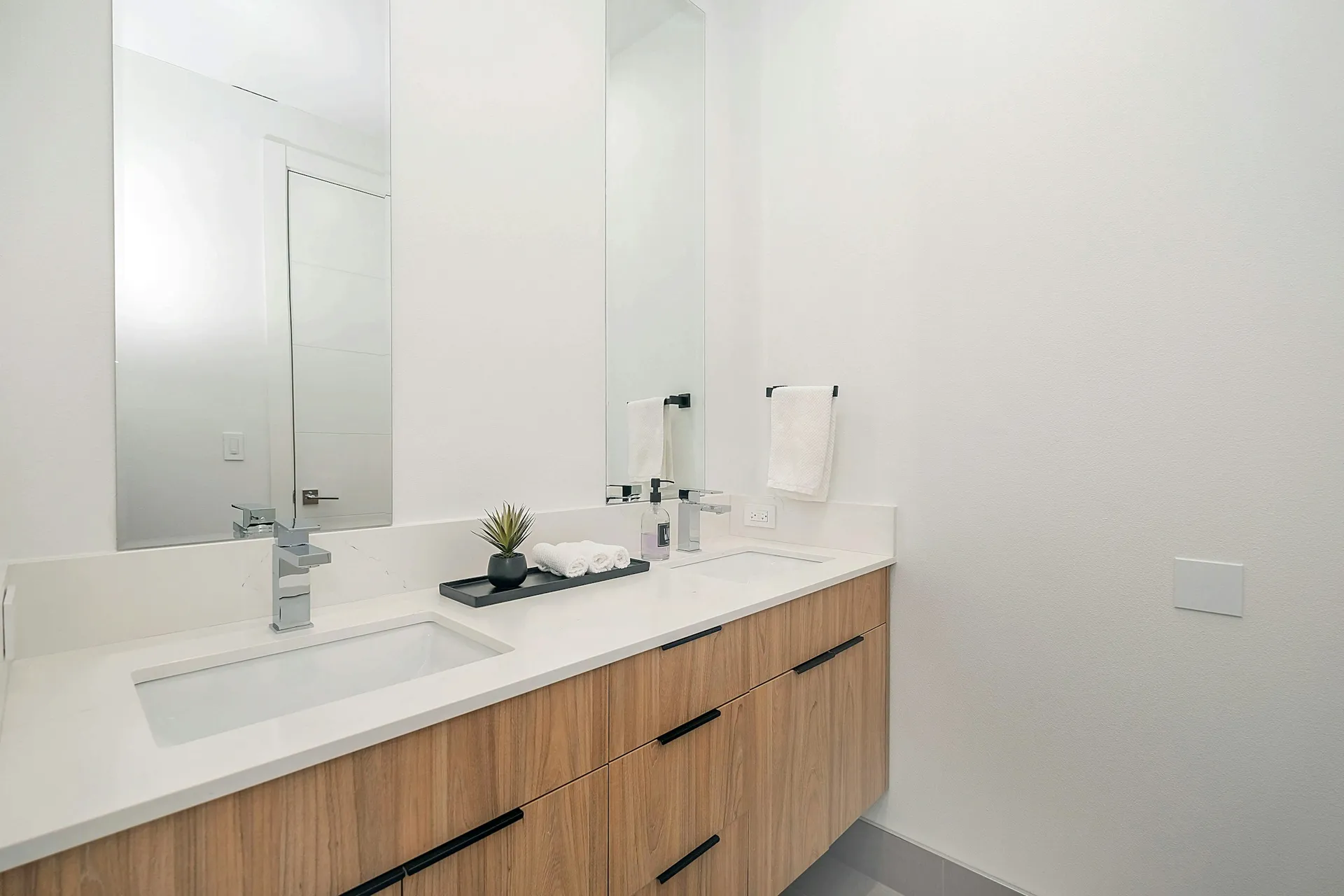
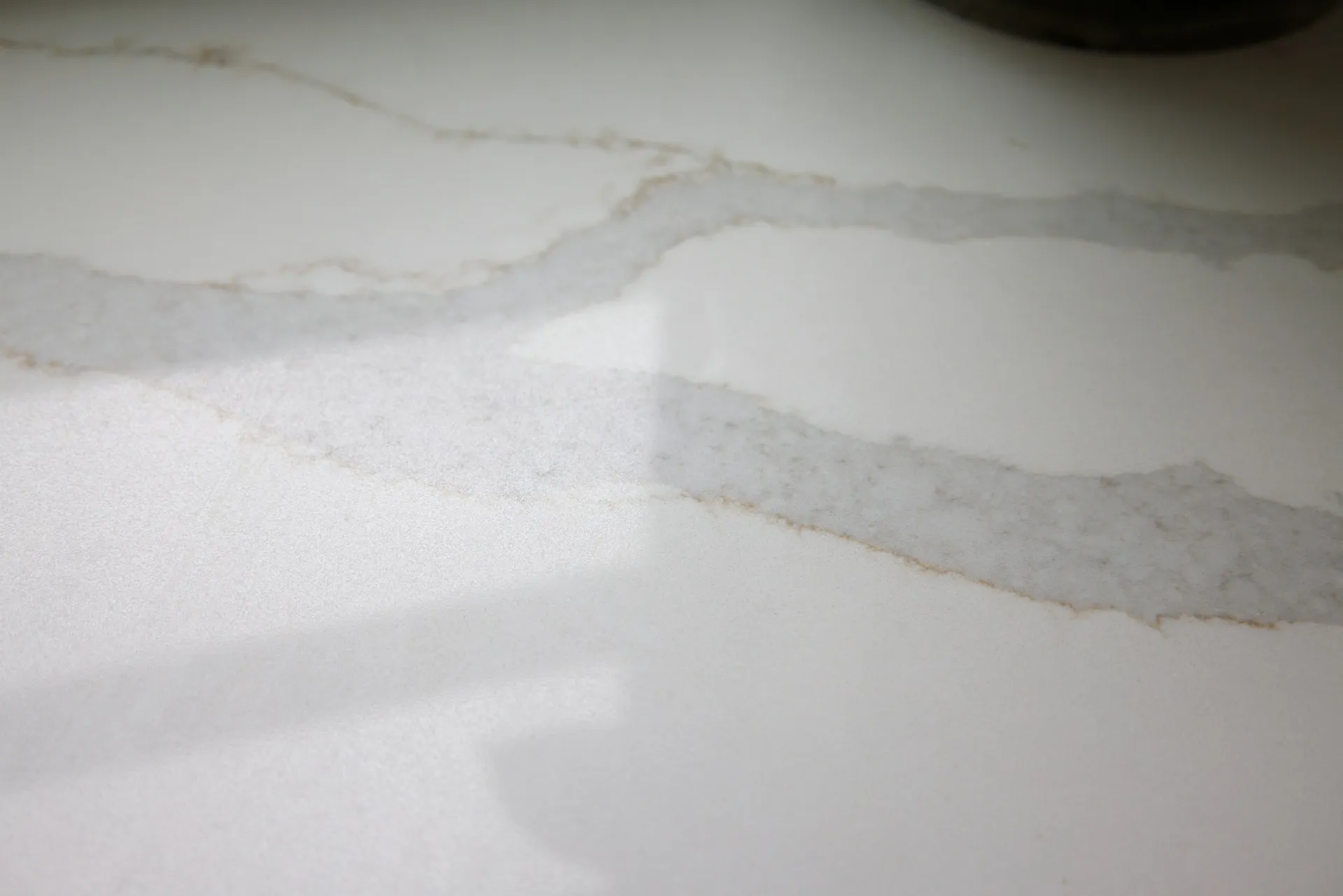
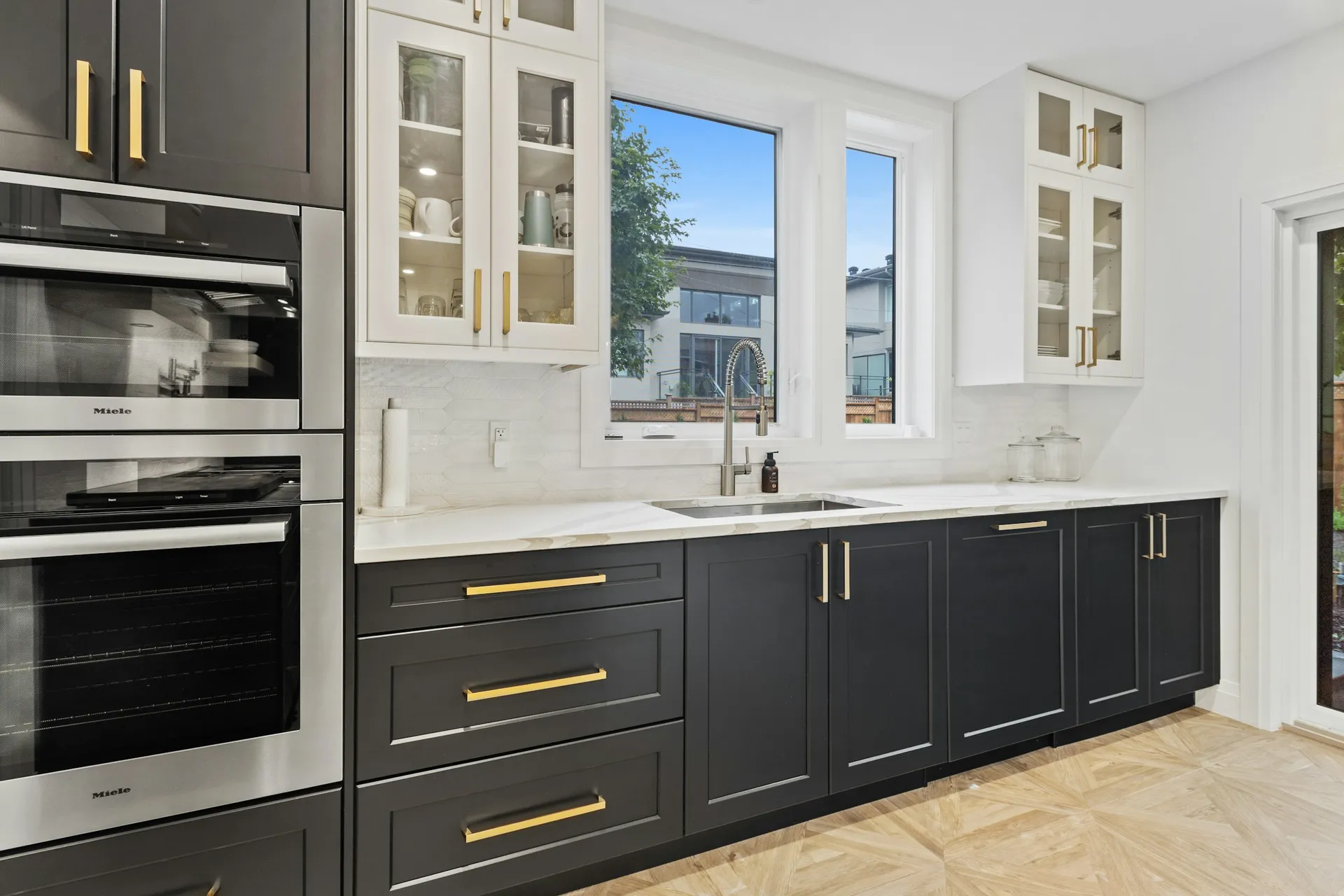
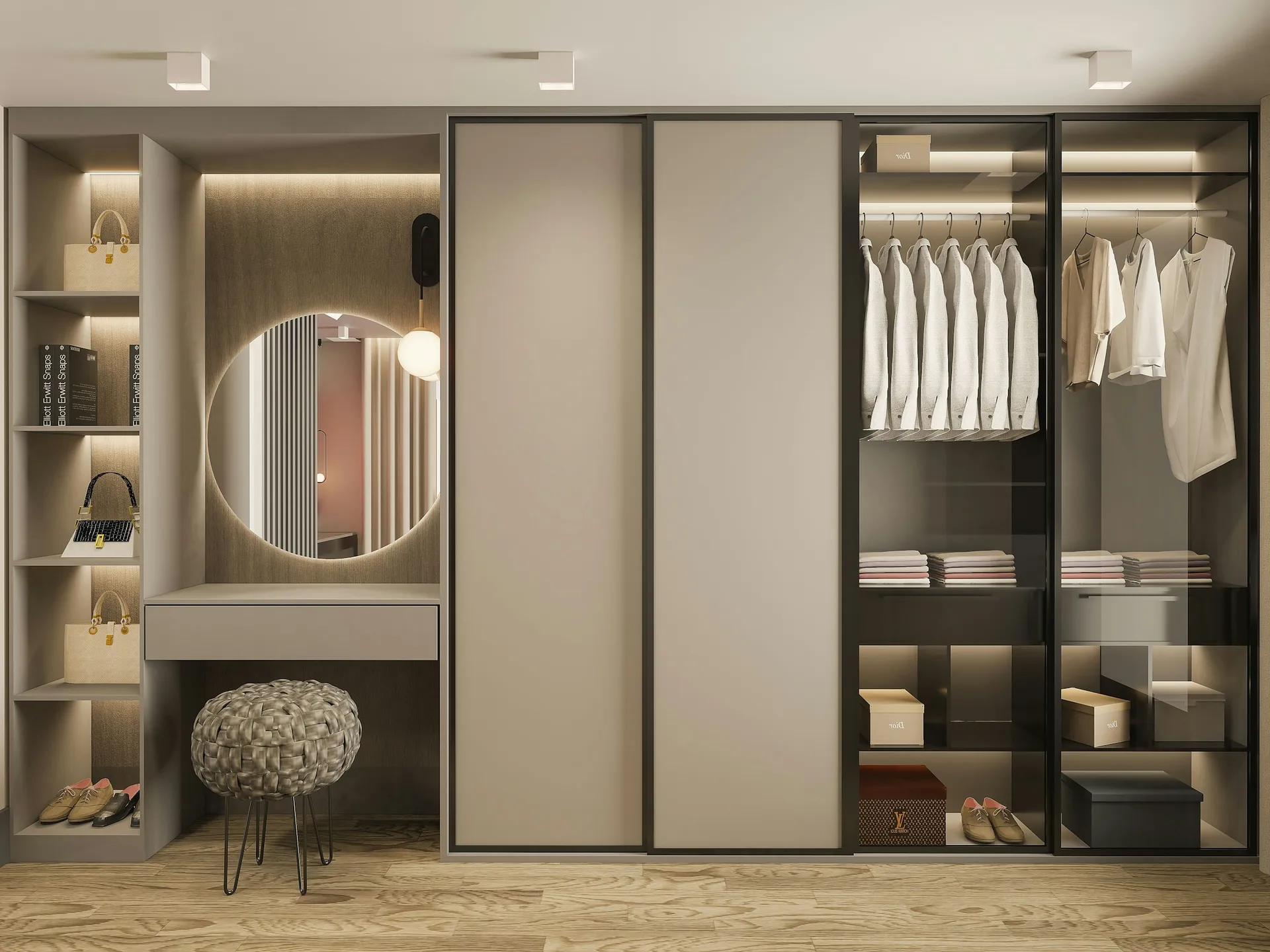
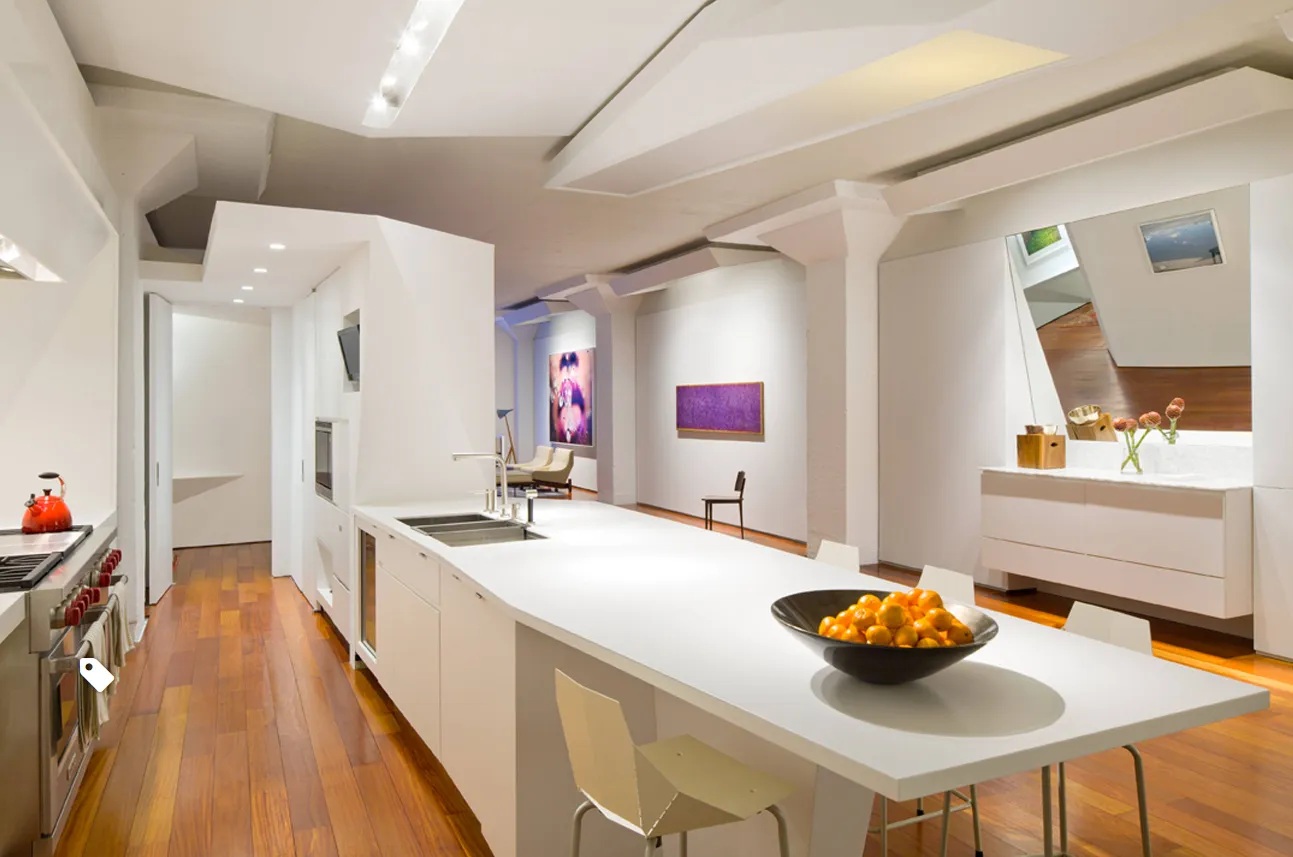
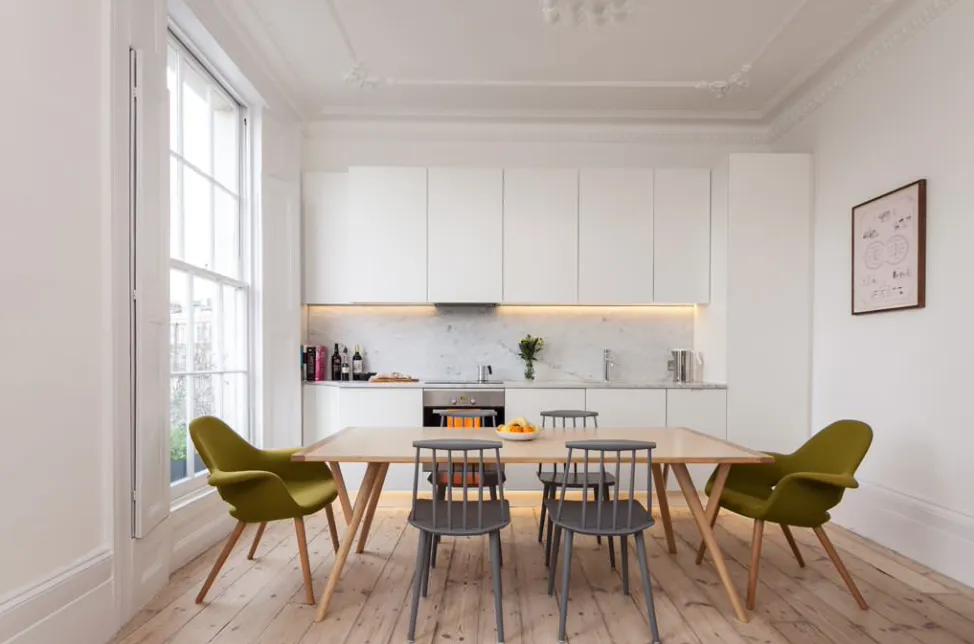
Every built-in cabinet has two parts: the board it is built from (the carcass and door core) and the finish on the surface. The finish decides how the cabinet looks, how it handles fingers, knocks and humidity, and a large part of the price. The board decides whether it sags, swells or releases formaldehyde.
In most Singapore homes, carpentry is quoted in laminate on plywood as the baseline. SmartCalculator estimates that wood veneer adds about 30% and spray paint about 45% to the per-foot-run price (indicative), which is why many owners use laminate throughout and save the premium finishes for one feature piece.
This page covers every finish a Singapore homeowner realistically chooses from: melamine board, high-pressure laminate, anti-fingerprint super-matte laminate, PET, acrylic high gloss, wood veneer, spray paint (2K lacquer) and solid wood. The buying guide then explains board types (plywood, MDF, particleboard), edge banding, formaldehyde emissions and certification, and what to ask your carpenter. For how these come together in specific pieces, see wardrobes and kitchen cabinets.
Carpentry finishes options at a glance
| Option | Cost | Durability | Upkeep | Best for |
|---|---|---|---|---|
| Melamine board (low-pressure laminate) | Budget | moderate | low | Cabinet interiors, shelves and budget furniture |
| High-pressure laminate (HPL) | Mid-range | excellent | low | Kitchen cabinets, wardrobes and most built-in carpentry |
| Anti-fingerprint super-matte laminate | Upper | good | low | Handleless doors, dark colours and high-touch kitchen fronts |
| PET panels | Mid-range | good | low | Modern kitchen and wardrobe doors on a mid-range budget |
| Acrylic high gloss | Upper | good | high | Statement kitchen doors and contemporary feature cabinets |
| Wood veneer | Upper | good | medium | Feature walls, wardrobe doors and living room cabinets |
| Spray paint (2K or PU lacquer) | Premium | good | medium | Bespoke feature pieces, curved or routed doors and exact colours |
| Solid wood | Premium | excellent | high | Statement shelves, tabletops and heritage or Japanese-style pieces |
Cost is relative within carpentry finishes ($ budget to $$$$ premium). Actual prices depend on brand, size and workmanship, so compare itemised quotes.
Melamine board (low-pressure laminate)
- Budget Budget
- Durability: moderate
- Upkeep: low
A single decorative melamine paper pressed directly onto particleboard or MDF in the factory. The surface on most flat-pack furniture and many cabinet interiors.
Best for: Cabinet interiors, shelves and budget furniture
Pros
- Cheapest finished board, ready to cut and assemble
- Easy to wipe clean and resists light scratches
- Wide range of solid colours and woodgrains
Cons
- Thin surface layer chips more easily at edges and corners
- Less impact-resistant than high-pressure laminate
- Usually on particleboard, which swells if edges get wet
- Cannot be repaired once chipped
Supplier guidance describes melamine (low-pressure laminate, LPL) as a single melamine paper bonded to the board at lower pressure, suited to vertical and low-wear surfaces such as shelves and consoles. It is common for the inside of wardrobes and cabinets even when the doors use a better finish, which is a sensible way to save money.
Its weak point in Singapore is the core and edges. Ask what the core board is, insist on edge banding on every cut edge, and avoid it in wet areas like under the sink. A chipped melamine corner cannot be patched invisibly, so it suits areas that do not take knocks.
High-pressure laminate (HPL)
- Mid-range Mid-range
- Durability: excellent
- Upkeep: low
Layers of kraft paper and a decorative sheet fused with resins under high pressure, then glued onto plywood or MDF by the carpenter. The default finish for Singapore built-in carpentry.
Best for: Kitchen cabinets, wardrobes and most built-in carpentry
Pros
- Tough against impact, scratches and everyday stains
- Huge range of colours, woodgrains, stone looks and textures
- Affordable baseline in most carpentry quotations
- Easy to clean with a damp cloth
Cons
- Visible dark line at edges unless edge-banded or colour-matched
- Large areas of printed woodgrain can look synthetic
- Can delaminate if glue or pressing is poor, especially near heat or water
- Damage is hard to repair invisibly
Supplier material describes HPL as multiple layers of kraft paper bonded with melamine and phenolic resins under much higher pressure than melamine board, which is why it suits both vertical and horizontal surfaces and high-traffic areas such as kitchen cabinets. SmartCalculator's 2026 per-foot-run estimates assume laminate on plywood as the baseline.
Ask for samples in large sheets, not just small chips, because woodgrain and stone prints repeat. Textured or synchronised woodgrain laminates look more natural but cost more. Check that edges are banded in a matching colour, and keep laminate panels away from direct oven or hob heat. HPL is also used on worktops, though most Singapore kitchens now use stone (see countertops).
Anti-fingerprint super-matte laminate
- Upper Upper
- Durability: good
- Upkeep: low
A laminate with a very low-sheen, soft-touch surface treated to resist fingerprints. Popular for handleless kitchens and dark colours where ordinary finishes show every mark.
Best for: Handleless doors, dark colours and high-touch kitchen fronts
Pros
- Hides fingerprints and smudges far better than gloss
- Soft, modern matte look in deep colours
- Wipes clean easily
Cons
- Costs noticeably more than standard laminate
- Narrower colour range
- Performance varies between products, so test a sample
Several manufacturers make super-matte or anti-fingerprint laminates and panels, and performance differs by product. Before committing, ask for a sample, press your fingers on it, wipe it, and try a light scratch on the back. Ask the supplier how to clean it, since some surfaces react badly to abrasive pads or strong chemicals.
These finishes make most sense on doors you touch daily, such as handleless kitchen cabinets and wardrobe doors. For carcasses and interiors, standard laminate or melamine is fine and keeps the budget in check.
PET panels
- Mid-range Mid-range
- Durability: good
- Upkeep: low
Board faced with a polyethylene terephthalate (PET) film, available in high gloss and super-matte. A common mid-range choice for modern kitchen and wardrobe doors.
Best for: Modern kitchen and wardrobe doors on a mid-range budget
Pros
- Smooth, even colour with a seamless look
- Available in both gloss and matte finishes
- Often marketed as recyclable
- Generally more affordable than acrylic
Cons
- Gloss versions show fingerprints and fine scratches
- Edges rely on edge banding, which can look different from the face
- Not suitable for areas of direct heat
PET panels are usually supplied as pre-faced doors or boards. Supplier claims about scratch resistance compared with acrylic vary, so judge from samples rather than brochures. Check that the edge banding is colour-matched and laser or tightly glued, since a visible glue line spoils the seamless look.
As with all faced boards, the core matters: ask whether the panel is on MDF, particleboard or plywood, especially for kitchen base cabinets.
Acrylic high gloss
- Upper Upper
- Durability: good
- Upkeep: high
Doors faced with a solid acrylic sheet that gives a deep, mirror-like shine. A premium look for contemporary kitchens and feature cabinets.
Best for: Statement kitchen doors and contemporary feature cabinets
Pros
- Deepest gloss of the faced finishes
- Reflects light, which makes small spaces feel brighter
- Fine surface scratches can often be polished out
Cons
- Shows fingerprints, smudges and micro-scratches
- Needs soft cloths and gentle cleaners
- More expensive than laminate or PET
- Not recommended near direct heat
Acrylic suits owners who like a high-gloss look and do not mind wiping doors often. Use it on upper cabinets or feature pieces rather than every surface, and pair it with matte or laminate for the carcass and lower, high-traffic areas if fingerprints bother you.
Ask the supplier for cleaning instructions and avoid abrasive pads. Keep acrylic away from the hob and oven, where heat can distort it.
Wood veneer
- Upper Upper
- Durability: good
- Upkeep: medium
A thin slice of real timber glued onto plywood or MDF, then sealed with a clear coat. Gives genuine wood grain at a fraction of the cost of solid wood.
Best for: Feature walls, wardrobe doors and living room cabinets
Pros
- Real wood grain, colour variation and texture
- Can be stained or lacquered to the shade you want
- More stable than solid wood in humidity because of the core board
- Small scratches can sometimes be touched up
Cons
- SmartCalculator estimates about 30% more than laminate
- Less resistant to knocks, water and stains than laminate
- Can fade or change colour in direct sun
- Grain varies, so panels may not match perfectly
Veneer is best where you want real timber and the surface will not take heavy wear: wardrobe doors, feature wall panelling, TV consoles and doors. It is less suited to kitchen base cabinets near the sink.
Ask how the veneer is sealed (the coating does the protecting), whether panels are book-matched so the grain flows, and see a finished sample under your own lighting. In west-facing rooms, use curtains or blinds to limit UV fading. Clean with a soft, slightly damp cloth and wipe spills promptly.
Spray paint (2K or PU lacquer)
- Premium Premium
- Durability: good
- Upkeep: medium
Carpentry sprayed with layers of paint or lacquer, usually two-component (2K/2-pac) or polyurethane, for a seamless solid colour in matte, satin or gloss. Often called Duco.
Best for: Bespoke feature pieces, curved or routed doors and exact colours
Pros
- Any colour, matched to your paint scheme
- Seamless finish with no edge lines
- Works on curved, fluted and routed shapes laminate cannot follow
Cons
- SmartCalculator estimates about 45% more than laminate
- Edges and corners can chip with knocks
- Repairs need respraying to match the colour and sheen
- Longer lead time because of multi-stage sanding and coating
Spray paint is usually applied to MDF, which has a smooth, uniform surface that takes paint well. SmartCalculator describes it as the costliest finish because of the multi-stage sanding and coating process, and notes many owners use laminate throughout and spray paint only on a feature piece.
Ask how many coats are applied, whether the work is done in a spray booth, and how chips will be repaired later. Light colours show dirt and chips less than dark gloss. Keep spray-painted doors away from the wettest areas, and choose a satin or matte sheen if fingerprints matter.
Solid wood
- Premium Premium
- Durability: excellent
- Upkeep: high
Cabinets, shelves or tops made entirely from timber rather than a faced board. Warm and repairable, but it moves with humidity and is the most expensive option.
Best for: Statement shelves, tabletops and heritage or Japanese-style pieces
Pros
- Real timber throughout, so scratches can be sanded and refinished
- Ages well and lasts decades with care
- Warm look and feel that faced boards cannot match
Cons
- Most expensive finish
- Expands, contracts and can warp or crack with humidity changes
- Needs oiling or resealing and protection from water and sun
- Heavy, and wide panels need careful design to allow movement
Retailer guidance notes that untreated solid wood may warp or swell in Singapore humidity, especially without consistent air-conditioning, and that engineered boards are more dimensionally stable. For that reason, solid wood is usually used for shelves, tops, frames and loose furniture rather than large built-in doors.
Ask which species and whether it is kiln-dried, let the timber acclimatise on site, and design joints that allow movement. Oil finishes are easy to refresh but need regular care; lacquered finishes protect better but are harder to repair.
Choose the board first
The finish is only as good as the board under it. Ask every contractor to write the board type into the quotation.
Plywood
Thin layers of timber glued with the grain crossing. It holds screws well and is the most stable common board in humidity. SmartCalculator's 2026 carpentry rates assume a quality plywood carcass, and it recommends moisture-resistant or marine plywood for kitchens and bathroom vanities. Plywood is the safest default for kitchen base cabinets, vanities and wardrobes.
MDF (medium-density fibreboard)
Fine wood fibres pressed with resin into a dense, smooth board. It has no grain or knots, which makes it the best base for spray paint and some door panels. It is heavier than plywood and swells if water gets into unsealed edges, so keep it out of wet areas.
Particleboard (chipboard)
Wood chips bonded with resin, usually supplied already faced with melamine. It is the cheapest board and common in flat-pack furniture. Its exposed edges swell when water gets in and rarely recover, so it suits dry, light-use areas only.
Solid versus hollow-core
SmartCalculator advises asking whether panels are fully boarded or hollow-core. Hollow doors and fillers are cheaper but can warp over time.
Edge banding
Every cut edge of a board needs sealing. Edge banding (a strip of PVC, ABS or veneer glued to the edge) protects the core from moisture and gives a clean finish. Check that:
- All edges are banded, including hidden ones inside cabinets and under shelves.
- The colour matches the face, especially on handleless doors.
- Joints are tight with no visible glue line or gaps at corners.
Poorly sealed edges are the most common reason cabinets swell in Singapore kitchens and bathrooms.
Formaldehyde, emissions and certification
Most boards use resins that can release formaldehyde, and built-in carpentry puts a lot of board into an enclosed room. What official sources say:
- NEA recommends specifying low-formaldehyde building products in renovation contracts, and says consumers may ask furniture companies for the panels' formaldehyde emission test reports. NEA has a voluntary formaldehyde limit for indoor air in certain premises and states ventilation is the most effective way to remove formaldehyde.
- Certified products: NEA and the Ministry of Sustainability and the Environment point consumers to products certified under the Singapore Green Labelling Scheme (SGLS) or the Singapore Green Building Product scheme, which have low or non-detectable formaldehyde. SGLS has a "Panel Boards" criteria category, and certified boards can be checked in the SGLS online directory.
- Paints: MSE has stated that interior paints with formaldehyde are not allowed for sale in Singapore from 1 January 2026, which also matters for spray-painted carpentry.
- E0 and E1: board suppliers often label boards E1 or E0 for formaldehyde emissions. These classes are defined by different standards in different markets, so ask for the test report and the standard it refers to rather than relying on the label alone.
Finally, NEA warns that moving in too early increases exposure even when low-emission products are used. Ventilate well for as long as you can after carpentry is installed.
Matching finishes to rooms
- Kitchen: plywood or moisture-resistant carcass, HPL or anti-fingerprint laminate on doors, PET or acrylic if you want gloss. Keep veneer and spray paint away from the sink and hob.
- Bathroom vanities: moisture-resistant board, fully sealed edges, laminate or a waterproof material. See bathroom vanities.
- Bedrooms: laminate is the workhorse; veneer or spray paint for wardrobe doors if budget allows.
- Living room: where feature finishes earn their cost, such as a veneer TV wall or spray-painted fluted console.
What to ask your carpenter
- What board is used for the carcass, doors and shelves, and is it moisture-resistant where needed?
- Which laminate or finish range and code, and can I see a large sample?
- Are all edges banded, including hidden edges?
- Are doors solid or hollow-core?
- Can you provide emission test reports or SGLS certification for the boards?
- Which hinge and runner brands are included in the rate?
How finishes affect budget
Finishes are one of the biggest carpentry cost levers. Using SmartCalculator's indicative multipliers, the same wardrobe in veneer costs about 1.3 times the laminate price and about 1.45 times in spray paint. A practical approach is laminate for most carpentry, with one feature piece in veneer or spray paint. Make sure every quotation states the finish for every item so you can compare quotations fairly, and decide finishes before signing to avoid variation orders.
How JIAHOME helps
We specify the board and finish for every carpentry item in our itemised, unpriced quotation, so each contractor prices the same materials. See our packages.