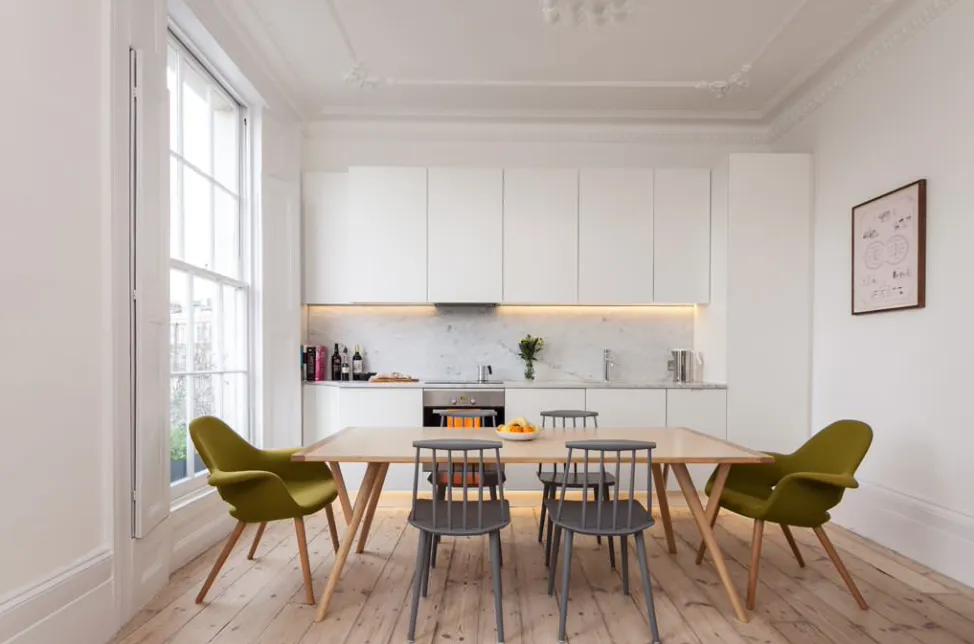
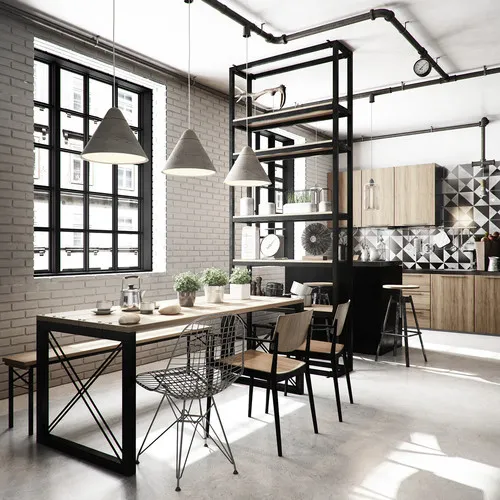
A dining table is one of the few pieces of furniture you touch every day: hot plates, wet cups, laptops, homework and the occasional spilled curry all land on it. In Singapore it often doubles as a work desk and sits in an open space shared with the living room and kitchen, so it needs to suit how you live as well as how it looks.
The decision has four parts:
- The top: solid wood, wood veneer, laminate, sintered stone or ceramic, natural marble, quartz, tempered glass or terrazzo. This decides how the table handles heat, stains, scratches and Singapore's humidity.
- The size and shape: rectangular, round, oval or square, and whether it extends.
- The base: four legs, a pedestal or a trestle, which affects legroom and how many chairs really fit.
- The seating: loose chairs, a bench, or a built-in banquette that adds storage.
Below we compare every top a Singapore homeowner realistically chooses from, plus extendable tables and built-in booth seating. The buying guide then covers sizing for HDB and condo dining areas, clearances, bases, delivery and care.
Dining tables options at a glance
| Option | Cost | Durability | Upkeep | Best for |
|---|---|---|---|---|
| Solid wood | Upper | excellent | medium | Families wanting a long-lasting table that can be refinished |
| Wood veneer on engineered board | Mid-range | good | medium | A real-wood look on a mid-range budget |
| Laminate (HPL or melamine) | Budget | good | low | Budget tables and hard-wearing family or study use |
| Sintered stone and ceramic | Upper | excellent | low | Families who cook and host often and want a marble look without the upkeep |
| Natural marble | Premium | good | high | Statement dining areas where looks come first |
| Quartz (engineered stone) | Upper | good | low | Matching a quartz kitchen countertop or island |
| Tempered glass | Mid-range | good | medium | Small HDB dining areas that need to feel open |
| Terrazzo | Upper | good | medium | Retro, eclectic or colourful dining spaces |
| Extendable table | Upper | good | medium | Small dining areas that host Chinese New Year, Hari Raya or Deepavali gatherings |
| Built-in banquette or booth seating | Mid-range | good | low | Compact HDB and condo dining nooks against a wall |
Cost is relative within dining tables ($ budget to $$$$ premium). Actual prices depend on brand, size and workmanship, so compare itemised quotes.
Solid wood
- Upper Upper
- Durability: excellent
- Upkeep: medium
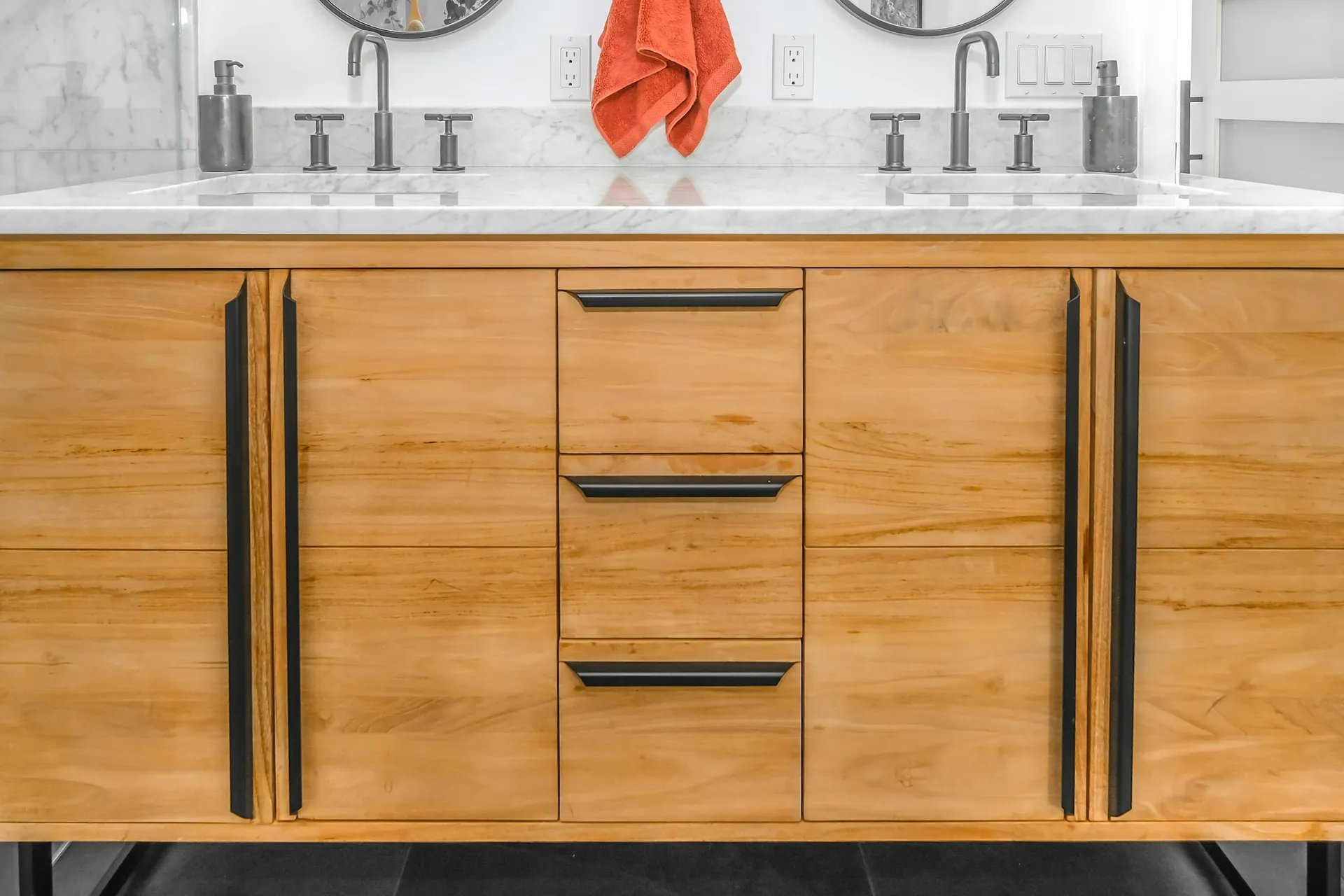
A top made from solid timber boards such as oak, walnut, teak or rubberwood. It suits homeowners who want a warm, natural table that can be sanded and refinished over the years.
Best for: Families wanting a long-lasting table that can be refinished
Pros
- Can be sanded and refinished when scratched or stained
- Warm look and feel that ages well
- Wide range from rubberwood (value) to oak, walnut and teak
- Very sturdy when well jointed
Cons
- Can move, crack or warp with swings in humidity and air-conditioning
- Needs a sealed finish and coasters; hot dishes and water rings can mark it
- Softer species such as walnut dent more easily
- Heavy, and premium species are expensive
Timber reacts to moisture, and Singapore's mean relative humidity is about 82% according to the Meteorological Service Singapore. A dining area that alternates between humid days and long hours of air-conditioning puts the most stress on solid wood, so ask how the timber was dried and how the top is jointed and fixed to the frame (good tables allow for some movement).
HipVan's guide rates teak as the most humidity and water resistant, oak as good for family use once sealed, and rubberwood as the value pick. Walnut is beautiful but softer and dents more readily. Check the finish: oiled tops look natural but need re-oiling, while lacquered tops resist spills better but are harder to spot-repair. Use placemats and trivets, wipe spills quickly, and keep the table out of direct afternoon sun.
Wood veneer on engineered board
- Mid-range Mid-range
- Durability: good
- Upkeep: medium
A thin layer of real timber bonded to plywood or MDF. It gives the look of solid wood at a lower price and weight, and is common in contemporary tables.
Best for: A real-wood look on a mid-range budget
Pros
- Looks like solid wood from above
- More stable than solid timber, so less warping
- Lighter and usually cheaper than solid wood
- Allows book-matched and consistent grain patterns
Cons
- Cannot be sanded back like solid wood; deep damage is hard to repair
- Edges can chip or peel if poorly finished
- MDF and particleboard cores swell if water gets in
- Quality varies widely between makers
Veneer tables are only as good as the core and the edges. Plywood cores are stronger and more moisture tolerant than MDF or particleboard, which absorb water if the finish is breached. HipVan's guide notes that veneers cannot be re-sanded and that thicker veneers can be prone to peeling, so inspect how the edges are sealed and wrapped.
In Singapore's humidity, look for a fully sealed underside as well as the top, because unsealed undersides let moisture in. Wipe spills promptly, avoid standing water around the edges, and use trivets for hot pots. A veneer table is a sensible middle ground for BTO and condo homes where a solid-wood look matters but budget and weight do too. If you are matching the table to built-in carpentry, see our guide to carpentry finishes.
Laminate (HPL or melamine)
- Budget Budget
- Durability: good
- Upkeep: low
A printed decorative layer fused onto an engineered board. High-pressure laminate (HPL) is the tougher version; melamine is the cheapest. Good for budget, rental and heavy family use.
Best for: Budget tables and hard-wearing family or study use
Pros
- Lowest cost of the common tops
- HPL resists scratches, heat and stains well
- Huge range of wood, stone and solid colours
- Easy to wipe clean
Cons
- Cannot be refinished; chips are permanent
- Melamine chips more easily and can lift if water reaches the core
- Prints can look flat compared with real materials
- Exposed edges are the weak point
HipVan's guide puts a laminate-on-MDF table at around $800 as a price benchmark (indicative only; check current prices). It also rates high-pressure laminate highly for scratch, heat and stain resistance, while warning that melamine chips and can lift with moisture over time in a humid climate.
Ask whether the surface is HPL or melamine, what the core is, and how the edges are finished (a thick, well-bonded edge band lasts much longer). Laminate is also the usual finish for built-in carpentry, so a laminate tabletop is easy to match to cabinets or a banquette made by your carpenter. It is a practical choice for young families, home offices that double as the dining table, and rental units.
Sintered stone and ceramic
- Upper Upper
- Durability: excellent
- Upkeep: low
Slabs made from natural minerals fused under heat and pressure, often printed to look like marble or concrete. Popular in Singapore for their resistance to heat, stains and scratches.
Best for: Families who cook and host often and want a marble look without the upkeep
Pros
- High heat resistance; Qanvast cites up to 300°C
- Resists stains such as curry, chilli and coffee
- Does not need sealing
- Many marble, stone and concrete looks
Cons
- Very heavy: HipVan cites 80 to 120 kg for a six-seater
- Edges and corners can chip with a hard knock
- The pattern is printed, so a chip shows the body colour
- Costs more than laminate or veneer
Sintered stone is made purely from natural minerals, according to Qanvast, which is why it handles heat far better than resin-bound quartz. Ceramic tops are similar but usually thinner and lighter, and HipVan's guide describes them as slightly less heat resistant than sintered stone.
The weight is the main practical issue. Check that the base is rated for the slab, and plan delivery: a large slab may need several people to carry it, and it has to fit in your lift and through corridors and doors. Ask for a rounded or bevelled edge, which chips less than a sharp square edge. Matte finishes look natural but can show water marks and fingerprints more than polished ones. HipVan benchmarks sintered stone and solid oak or walnut tables at $2,500 or more (indicative only).
Natural marble
- Premium Premium
- Durability: good
- Upkeep: high
Quarried stone with unique veining, such as Carrara or Calacatta. A statement material for homeowners who accept that it will etch and patina with use.
Best for: Statement dining areas where looks come first
Pros
- Every slab is unique
- Cool, luxurious feel
- Stays cool to the touch in a warm climate
- Can be professionally honed and repolished
Cons
- Etches from acids such as lime, vinegar and wine
- Porous: stains from oil, coffee and curry if not sealed
- Needs resealing, typically every 6 to 12 months
- Heavy and among the most expensive tops
Marble is mostly calcium carbonate, so acidic food and drink dulls the polish (etching) even when the surface is sealed. HipVan's guide recommends resealing every 6 to 12 months. A honed (matte) finish hides etching better than a high polish.
Marble suits homes where the table is used for dining rather than as a daily kitchen worktop or kids' craft table. Use coasters and placemats, wipe spills immediately, and clean with a pH-neutral cleaner. Like sintered stone, it is heavy, so check the base and the delivery route. If you love the look but not the upkeep, compare engineered marble, sintered stone or a marble-look laminate. See also our countertops guide for how the same stones perform in the kitchen.
Quartz (engineered stone)
- Upper Upper
- Durability: good
- Upkeep: low
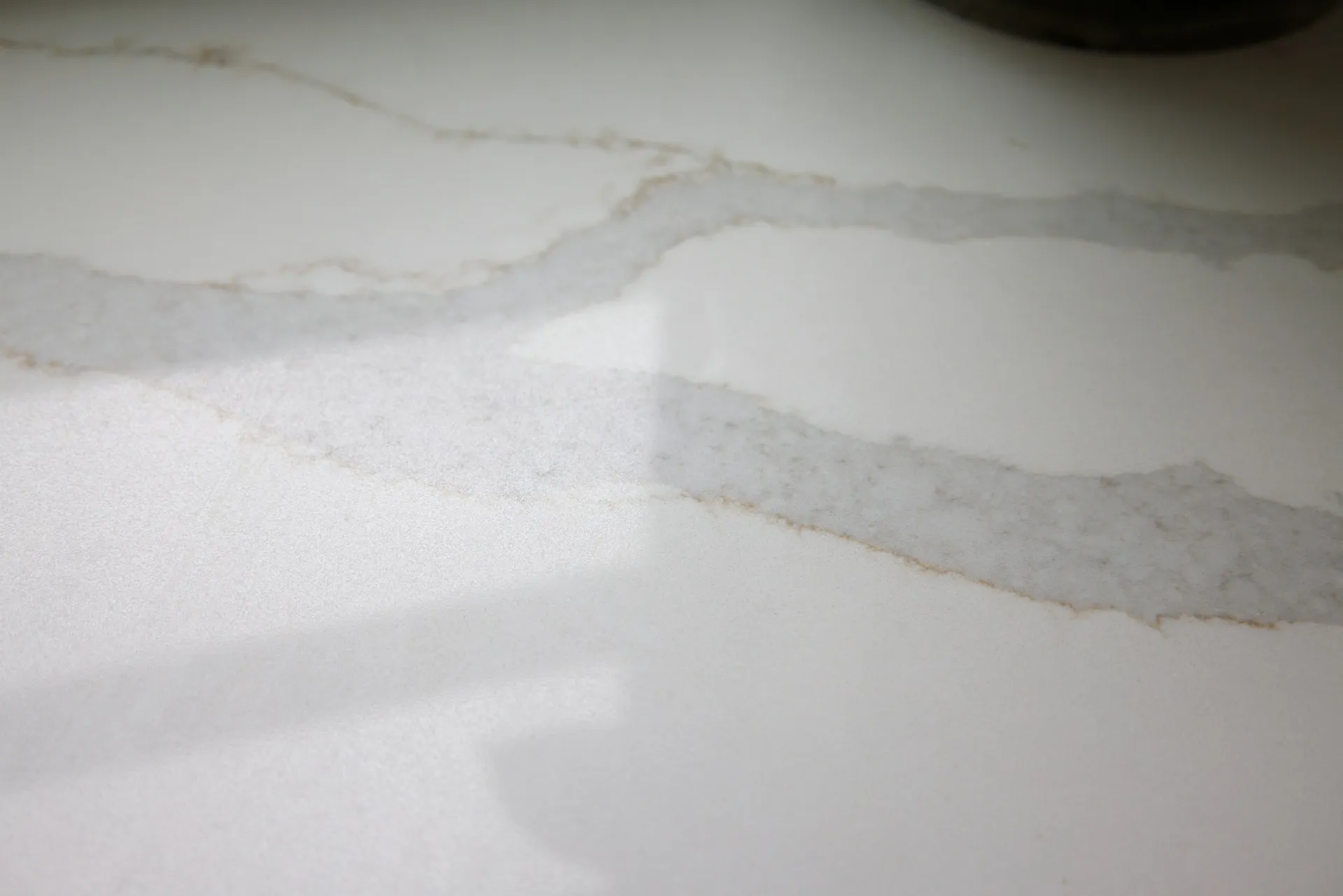
Crushed natural quartz bound with resin and pigments. Familiar from kitchen countertops, it is a hard, non-porous tabletop with a consistent look.
Best for: Matching a quartz kitchen countertop or island
Pros
- Non-porous, so resists everyday stains
- Consistent colour and pattern
- No sealing needed
- Can be fabricated to match your kitchen counter
Cons
- Resin limits heat resistance; Qanvast cites up to about 100°C
- Can discolour in long periods of direct sun
- Heavy, with chip-prone corners
- Usually custom fabricated, so lead times are longer
Qanvast describes quartz as natural quartz combined with pigments and resin binders, and contrasts its heat tolerance (up to about 100°C) with sintered stone (up to about 300°C). Always use trivets for pots and hot plates. Renonation reports that quartz can yellow or grey when left in strong direct sunlight for long periods, so avoid placing a pale quartz table right by a west-facing window.
Quartz tables are often made by countertop fabricators rather than furniture shops, which is useful if you want the table to match a kitchen island. Agree the thickness, edge profile and base design in writing, and check the frame can carry the weight.
Tempered glass
- Mid-range Mid-range
- Durability: good
- Upkeep: medium
Toughened glass tops on metal or wood bases. Light and see-through, they help small dining areas feel bigger.
Best for: Small HDB dining areas that need to feel open
Pros
- Makes a small space feel lighter and larger
- Unaffected by humidity
- Tempered glass breaks into blunt pieces rather than sharp shards
- Easy to wipe; does not stain
Cons
- Shows fingerprints, smudges and water marks constantly
- Can scratch with fine hairline marks
- Noisy with plates and cutlery; glare under bright lights
- Cold, hard edges are a concern with toddlers
Make sure the glass is tempered (toughened), which is designed to break into small blunt pieces. HipVan's guide notes its excellent humidity tolerance but also the constant fingerprints, hairline scratches and glare.
Glass works best in compact BTO dining areas or open-plan spaces where a solid top would feel heavy. Choose a low-iron (extra clear) or tinted glass if the green edge of standard glass bothers you, and a bevelled or polished edge for safety. Use placemats to reduce scratches and noise, and check how the glass is secured to the base.
Terrazzo
- Upper Upper
- Durability: good
- Upkeep: medium
Chips of marble, stone or glass set in a cement or resin binder and polished. A playful, retro-modern material that suits colourful interiors.
Best for: Retro, eclectic or colourful dining spaces
Pros
- Distinctive speckled look; can be custom coloured
- More forgiving of marks than plain marble
- Hard-wearing surface
- Pairs well with Singapore retro and Peranakan styles
Cons
- Cement-based terrazzo is porous and needs sealing
- Can still etch where marble chips are exposed
- Heavy; chips at sharp edges
- Fewer ready-made options, so often custom
HipVan's guide describes terrazzo as more forgiving than marble but porous, so it needs sealing. Ask whether the binder is cement or resin: resin terrazzo is less porous but less heat tolerant, while cement terrazzo needs a good sealer and more care with oils and acids.
Terrazzo tabletops suit Retro and Peranakan interiors, and can be paired with terrazzo-look tiles elsewhere. Use trivets and coasters, wipe spills promptly and reseal as the maker advises.
Extendable table
- Upper Upper
- Durability: good
- Upkeep: medium
A table with a leaf or sliding mechanism that adds length when needed. Ideal for homes that seat four daily but host family on festive days.
Best for: Small dining areas that host Chinese New Year, Hari Raya or Deepavali gatherings
Pros
- Saves space for most of the year
- Seats more guests when extended
- Available in wood, veneer, laminate, glass and sintered stone
- Avoids buying a second table for occasions
Cons
- Mechanisms add cost and can loosen over time
- Leaves may not match the top perfectly as it ages
- Stone versions are very heavy to extend
- You still need room for the extended size and extra chairs
Before buying, measure the dining area for the extended size plus clearance for chairs, not only the closed size. Check how the leaf is stored (built-in butterfly leaves are easier than loose ones you have to keep elsewhere), how smooth the slides are, and whether one person can extend it.
Solid wood leaves can age to a slightly different colour from the main top if they are always stored away, so extend the table now and then. For stone or sintered tops, try the mechanism in the showroom because the weight makes some designs hard to use. Leg position matters too: on extended tables, legs at the corners keep the ends usable.
Built-in banquette or booth seating
- Mid-range Mid-range
- Durability: good
- Upkeep: low
A fixed bench along a wall or window, made by your carpenter, paired with a table. It saves floor space and adds storage under the seat.
Best for: Compact HDB and condo dining nooks against a wall
Pros
- Uses less floor space than chairs on that side
- Lift-up or drawer storage under the seat
- Seats more people, especially children
- Can be matched to kitchen carpentry
Cons
- Fixed: hard to rearrange or take with you
- Getting in and out of the middle is awkward
- Upholstered cushions need care in humid weather
- Must be planned before carpentry is measured
Fine Homebuilding's banquette examples use a finished seat height of about 18 inches (about 46 cm), a seat depth of about 18 inches and a seat-back angle of 7 to 9 degrees. Match the seat height to your table height (about 75 cm is typical, according to HipVan) so knees fit underneath.
A pedestal or trestle table works best with a banquette, because legs at the corners get in the way when sliding in. Choose wipeable upholstery or loose cushions with removable covers, and leave ventilation in the storage base so it does not trap damp. Add a power point near the banquette if the table will double as a workspace. Because a banquette is carpentry, it needs to be in the drawings before your contractor quotes, otherwise it becomes a variation order.
Size the table to the room first
Measure the dining area, then subtract clearance. HipVan's guide suggests about 60 cm of table edge per diner (10 to 15 cm more if dishes go down the middle), at least 75 cm of walkway behind chairs, and about 90 cm as a comfortable ideal. Room & Board recommends at least 36 inches (about 90 cm) of clearance on all sides. In practice, a table that is too big is the most common mistake in HDB flats, where the dining area often doubles as a corridor between the kitchen and living room.
Typical sizes from HipVan's guide:
- 4-seater rectangular: about 120 x 75 cm
- 6-seater rectangular: about 160 to 180 x 80 to 90 cm
- 8-seater rectangular: about 200 to 220 x 90 to 100 cm
- 4-seater round: about 100 to 110 cm diameter
- Table height: about 75 cm, with chair seats about 45 cm high
A quick test: mark the table outline on the floor with masking tape, add chairs pulled out, and walk around it.
Choose the shape for your layout
- Rectangular: the most versatile; fits long, narrow dining areas and seats the most people.
- Round: no corners, easier to move around, and good for conversation. It suits square spaces and up to about six people.
- Oval: seats like a rectangle but with softer ends that ease tight walkways.
- Square: intimate for two to four, and can sit against a wall when not in use.
Pick the right base
- Four legs: sturdy and common, but legs set in from the corners can clash with knees.
- Pedestal: maximum legroom and easy to squeeze an extra chair in. Heavy stone tops need a properly weighted base.
- Trestle or sled: good legroom along the sides, less at the ends.
Check how the base is fixed to the top, especially for stone, and whether the frame is solid wood, metal or engineered board.
Match the top to how you live
- Heavy daily use with kids: HPL laminate, sintered stone or a sealed solid wood you can refinish.
- Hot dishes straight from the stove: sintered stone handles heat best; quartz, laminate and wood need trivets.
- Entertaining and statement looks: marble or terrazzo, if you accept etching and sealing.
- Small, dark dining area: tempered glass or a light-coloured top keeps the space feeling open.
- Working from the dining table: a matte surface that does not glare, and a power point nearby.
Singapore climate and care
With mean relative humidity around 82% (Meteorological Service Singapore), moisture is the biggest enemy of wood and engineered boards. Choose sealed undersides, avoid placing timber tables against walls that get damp, and do not put wood directly under an air-conditioner outlet. Porous stones need sealing; sintered stone and glass do not.
Questions to ask the seller
- What is the core material (solid wood, plywood, MDF, particleboard)?
- For stone: what is the thickness and total weight, and is the base rated for it?
- How is the edge finished, and what does the warranty cover (warping, chipping, peeling)?
- Will it fit in the lift and through the main door, or is it delivered in parts?
- How should it be cleaned, and does it need sealing or oiling?
Budget
HipVan's guide gives these indicative benchmarks: about $800 for laminate on MDF, about $1,500 for solid rubberwood, and $2,500 or more for sintered stone, solid oak or walnut. Treat these as starting points only. Built-in banquettes are priced as carpentry, so get them itemised in your renovation quote.
Plan the dining area with the rest of the home
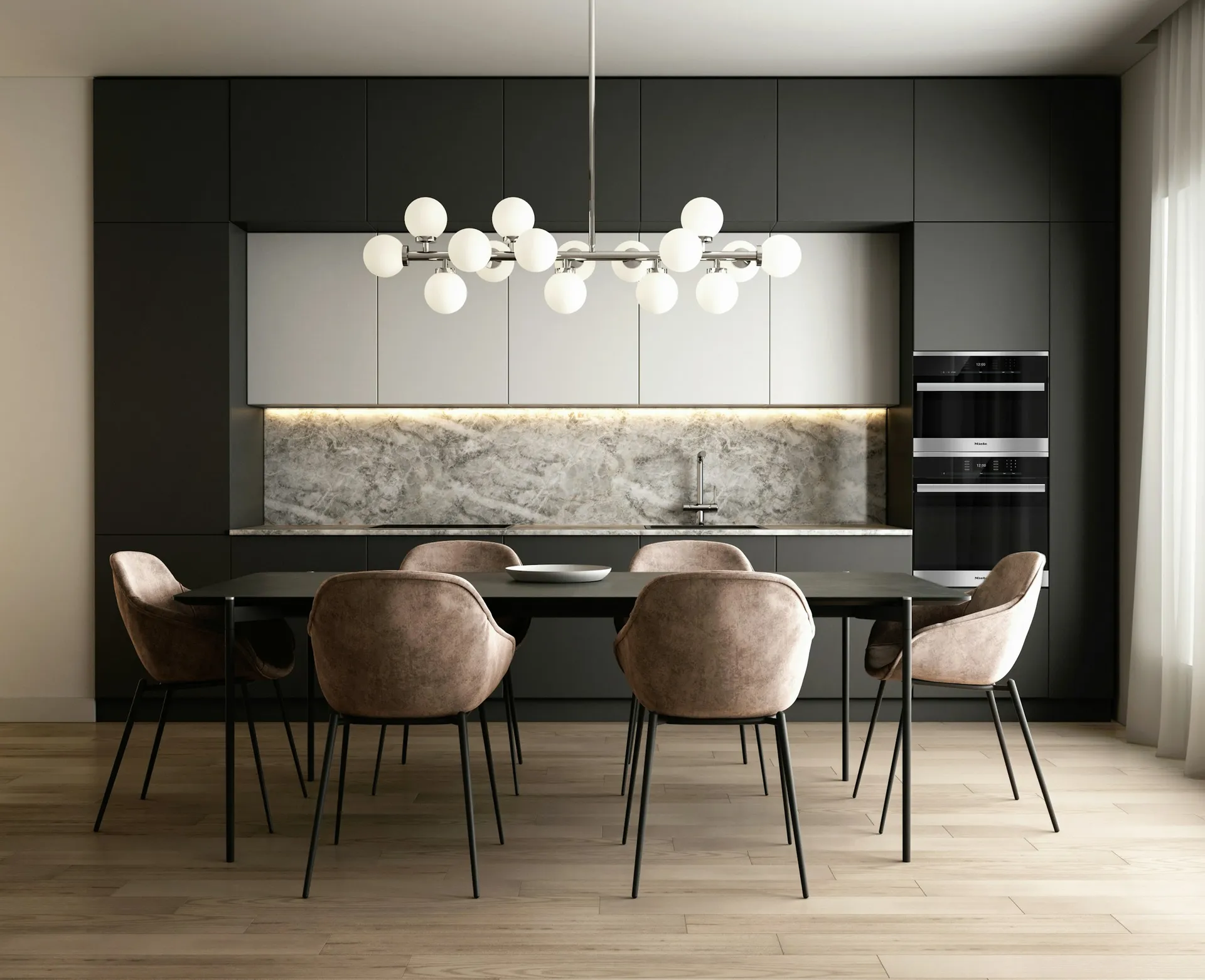
The table, pendant light, power points and any banquette all need to line up. Fix the table position before your electrician sets the light point, so the pendant hangs over the centre of the table. See our lighting guide. JIAHOME designs the layout in 2D and 3D first so these details are settled before any contractor quotes. See our services.