A kitchen cabinet is two decisions, not one: the carcass (the box that carries the weight and sits next to the sink and pipes) and the door finish (what you see and touch every day). Most quotes in Singapore bundle them into a single per-foot-run rate, which makes it easy to compare prices and hard to compare quality.
In a humid climate, the carcass decides how long the kitchen lasts. Water from the sink, steam from the rice cooker and the occasional pipe leak find their way into the cabinet below the sink first, and a board that swells there drags the whole run down with it. The door finish decides how the kitchen looks after five years of oily fingers, wok splashes and cleaning.
This page covers every carcass and door option a Singapore homeowner is realistically offered today, from the standard laminate-on-plywood kitchen found in most BTO flats to aluminium, stainless steel, 2K spray lacquer, veneer, solid wood, acrylic and glass. Hardware (hinges, runners and handles) is covered in the buying guide, because it fails long before a good carcass does. Prices are indicative estimates from published guides, not quotations.
Kitchen cabinets options at a glance
| Option | Cost | Durability | Upkeep | Best for |
|---|---|---|---|---|
| Laminate on plywood (standard carcass) | Budget | good | low | Most BTO and resale HDB kitchens on a sensible budget |
| Melamine-faced particleboard or MDF | Budget | moderate | low | Flat-pack kitchens, rental units and dry cabinets away from the sink |
| Moisture-resistant or marine plywood carcass | Mid-range | good | low | Sink and dishwasher cabinets in any HDB or condo kitchen |
| PVC foam board carcass | Mid-range | good | low | Under-sink cabinets and kitchens with a history of leaks or termites |
| Aluminium cabinets | Upper | excellent | low | Wet kitchens, heavy cooks and termite-prone homes |
| Stainless steel cabinets | Premium | excellent | medium | Serious home cooks, wet kitchens and industrial-style homes |
| 2K spray lacquer (painted) doors | Upper | good | medium | Handle-less modern kitchens and custom colour schemes |
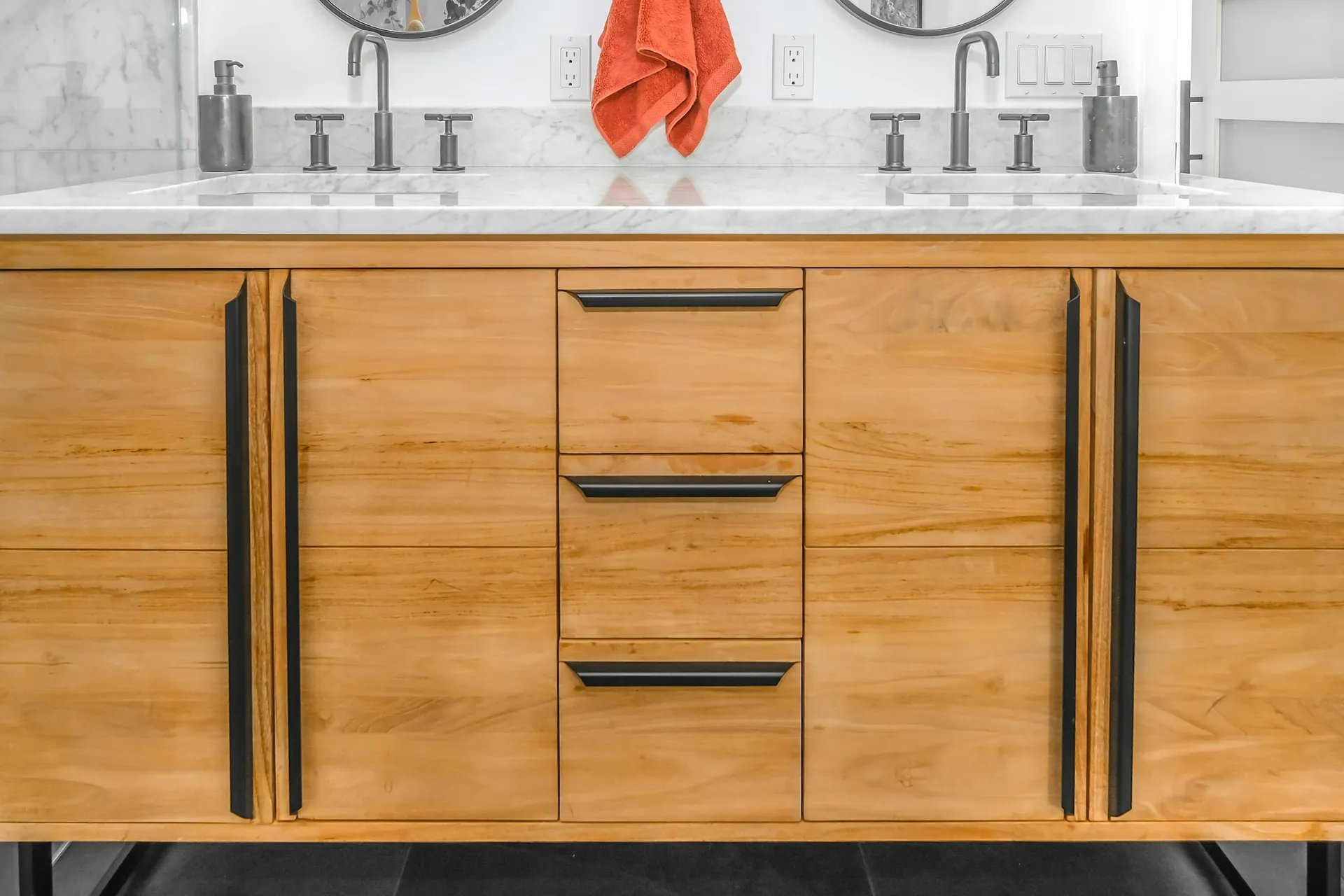
| Wood veneer doors | Upper | good | medium | Japandi, Scandinavian and Muji-style kitchens in dry areas |
| Solid wood doors | Premium | good | high | Classic, rustic and colonial-style kitchens in condos and landed homes |
| Acrylic (high-gloss) doors | Mid-range | good | medium | Modern and contemporary kitchens that want gloss without spray paint |
| Glass and aluminium-frame glass doors | Upper | good | medium | Wall units, display cabinets and breaking up a long run of solid doors |
Cost is relative within kitchen cabinets ($ budget to $$$$ premium). Actual prices depend on brand, size and workmanship, so compare itemised quotes.
Laminate on plywood (standard carcass)
- Budget Budget
- Durability: good
- Upkeep: low
A plywood carcass and doors faced with high-pressure laminate (HPL). This is the default kitchen in most Singapore BTO and resale renovations, and the baseline that every other option is priced against.
Best for: Most BTO and resale HDB kitchens on a sensible budget
Pros
- The most cost-efficient finish, used as the pricing baseline in most quotes
- Huge range of colours, woodgrains and stone looks
- Hard-wearing surface that wipes clean with mild detergent
- Plywood holds screws and hinges well over time
Cons
- Plywood core can swell if cut edges are left unsealed, especially near the sink
- Visible edge banding on doors; cheap edging can peel in heat and humidity
- Not repairable once chipped; the panel has to be replaced
- Standard plywood is not waterproof
SmartCalculator estimates laminate kitchen cabinets with a plywood carcass at about $100 to $160 per foot for top units and $120 to $190 per foot for bottom units (2026, indicative), with top and bottom priced separately. It puts a mid-spec laminate kitchen for a typical HDB L-shaped layout at roughly $5,000 to $6,500, excluding the countertop.
What to check:
- Edge banding: ask for thick PVC or ABS edging on all exposed edges, applied by machine, not thin tape.
- Sink cabinet: ask for moisture-resistant ply or PVC foam board for the cabinet below the sink, and sealed cut edges where the waste pipe passes through.
- Back panels: some quotes use thin backing boards. Ask what thickness the back and shelves are.
Melamine-faced particleboard or MDF
- Budget Budget
- Durability: moderate
- Upkeep: low
Boards made from wood chips (particleboard) or wood fibres (MDF) faced with a thin melamine paper. Common in flat-pack and modular kitchens, where precise factory cutting and edging keep costs down.
Best for: Flat-pack kitchens, rental units and dry cabinets away from the sink
Pros
- Lowest material cost, factory-cut and edged to tight tolerances
- Very flat, stable panels that do not warp in dry conditions
- Quick to install, often with a modular system of standard sizes
- Easy to replace individual doors and panels
Cons
- Swells and crumbles if water gets into a cut edge or screw hole
- Weaker screw holding than plywood, so hinges can loosen with repeated use
- Heavy for its strength; long shelves can sag
- SmartCalculator notes that standard MDF or untreated board around the sink can warp within a few years in Singapore
Particleboard (also called chipboard) and MDF are perfectly usable for cabinets that stay dry: wall units, pantry columns and drawers away from the sink and dishwasher. The risk is concentrated in the sink cabinet and the cabinet next to the dishwasher, where water reaches unsealed edges.
If you are buying a flat-pack kitchen, ask whether a moisture-resistant board (often green-cored) is available for the sink cabinet, and seal any holes you cut for pipes. Also ask about the board's formaldehyde emission class, as boards are sold to different emission grades and lower-emission boards are better for an enclosed kitchen.
Melamine is a thinner, softer surface than HPL laminate, so it chips more easily at door edges.
Moisture-resistant or marine plywood carcass
- Mid-range Mid-range
- Durability: good
- Upkeep: low
A plywood carcass made with water-resistant glue and better veneers, used either throughout or just for the sink and wet zones. The most common upgrade on a standard laminate kitchen.
Best for: Sink and dishwasher cabinets in any HDB or condo kitchen
Pros
- Much better tolerance of splashes and occasional leaks than standard ply
- Keeps plywood screw holding for hinges and runners
- Works with any door finish (laminate, paint, veneer)
- Cheap upgrade if limited to the wet zone
Cons
- Still wood: it resists water but is not waterproof if left wet
- Grades and labels vary; 'marine' is sometimes used loosely
- Termites can still attack wood-based boards
- Costs more if specified for the whole kitchen
SmartCalculator lists moisture-resistant or marine ply as an upgrade of about $15 to $30 per foot (roughly 10 to 20%) over a standard plywood carcass (2026, indicative). Its worked example applies it to only about 4 feet of a typical HDB kitchen: the sink run.
That is usually the right approach. You get most of the benefit for a small cost by upgrading the sink cabinet and the cabinet beside the dishwasher, then using standard ply elsewhere.
Ask your contractor to write the board grade on the quotation (for example, "moisture-resistant plywood carcass for sink cabinet, 2 units") rather than just "plywood". If the term is vague on paper, you cannot check it on site.
PVC foam board carcass
- Mid-range Mid-range
- Durability: good
- Upkeep: low
Lightweight plastic boards that do not absorb water and are not eaten by termites. Increasingly used for sink cabinets and wet-area carpentry, sometimes combined with laminate doors.
Best for: Under-sink cabinets and kitchens with a history of leaks or termites
Pros
- Does not swell or rot when wet
- Termite-proof
- Light and easy to cut
- Can be faced with laminate to match the rest of the kitchen
Cons
- Weaker screw holding than plywood; hinges can work loose
- Boards can sag under heavy loads on long spans
- Quality varies widely between boards of different densities
- Fewer contractors are experienced with it than with plywood
The common, sensible combination is a plywood kitchen with a PVC foam board sink cabinet. You keep plywood's strength for wall units and drawers, and put the waterproof board where water actually goes.
Ask about board density and thickness, and whether the hinge positions are reinforced or use fixings designed for the material. Thin, low-density boards are where most complaints come from.
Because it does not absorb water, a leak under a PVC cabinet may go unnoticed for longer. Do not block HDB's sanitary duct weepholes in the kitchen with carpentry, as HDB notes these alert you to leaks inside enclosed ducts.
Aluminium cabinets
- Upper Upper
- Durability: excellent
- Upkeep: low
Cabinets built from aluminium profiles and panels, often with aluminium-framed or laminate-faced doors. Popular in Singapore for wet kitchens and for owners who want a no-swell, termite-proof carcass.
Best for: Wet kitchens, heavy cooks and termite-prone homes
Pros
- Described as fully waterproof, termite-proof and warp-proof
- Long service life; SmartCalculator puts it at 10 to 20 years
- Lightweight and does not rust
- Available with a range of door looks, including woodgrain and stone
Cons
- Costs more than a laminate kitchen
- Visible profiles and joints on cheaper systems can look utilitarian
- Panels can dent on impact
- Fewer options for curves, custom sizes and integrated appliances
SmartCalculator estimates aluminium cabinets at $160 to $260 per foot for top units and $190 to $320 per foot for bottom units (2026, indicative). Its worked example puts an aluminium HDB kitchen at about $7,560 against about $5,650 for laminate on the same layout.
Aluminium kitchens vary a lot. Ask about profile thickness, whether panels are honeycomb or solid, how the hinges are fixed, and whether the door finish is a powder coat, a film or a laminate. Look at a showroom unit that has been in use, not only a new display, and open and close the doors to feel the hinges.
Aluminium suits a "wet kitchen" in the service yard or a dedicated heavy-cooking zone, even if the open dry kitchen uses wood-based cabinets.
Stainless steel cabinets
- Premium Premium
- Durability: excellent
- Upkeep: medium
Fully stainless steel carcasses and doors, the material of commercial kitchens. The toughest and longest-lasting option, with a professional look that suits heavy cooking.
Best for: Serious home cooks, wet kitchens and industrial-style homes
Pros
- Completely waterproof and termite-proof
- Heat-resistant and hygienic, easy to sanitise
- Longest lifespan; SmartCalculator puts it at 20 years and more
- Works with an integrated stainless steel worktop and sink
Cons
- The most expensive carcass option
- Shows fingerprints, water marks and fine scratches
- Can dent and is noisy when doors close
- The look is not for everyone in an open kitchen
SmartCalculator estimates stainless steel cabinets at about $210 to $320 per foot for top units and $240 to $390 per foot for bottom units (2026, indicative), the highest of the common options.
Ask what grade of stainless steel is used (304 is a common grade for kitchen use) and what thickness. A brushed or textured finish hides fingerprints and scratches much better than a mirror finish.
A popular compromise is stainless steel for the bottom cabinets in a wet kitchen, where water and heat are concentrated, with laminate or painted wall units above. If you want the industrial look without the cost, a laminate kitchen with a stainless steel worktop gets you most of the way.
2K spray lacquer (painted) doors
- Upper Upper
- Durability: good
- Upkeep: medium
Doors (usually MDF) sprayed with a two-component paint in any colour and sheen, for a seamless, handle-less look. Also called 2-pac, Duco or PU finish.
Best for: Handle-less modern kitchens and custom colour schemes
Pros
- Any colour, in matt, satin or gloss
- Seamless finish with no edge banding lines
- Hard, car-like surface when done well
- Can be touched up or resprayed
Cons
- SmartCalculator estimates about 45% more than laminate
- Chips at edges and corners under knocks
- Quality depends heavily on the spray workshop
- Gloss shows fingerprints and imperfections
SmartCalculator's carpentry guide puts spray paint (2-pac, Duco or PU) at about 1.45 times the laminate rate (2026, indicative).
Spray lacquer is applied in a workshop, so ask how many coats of primer and topcoat are used, whether the edges are sealed, and whether you can see doors finished by the same workshop that have been in use for a year or two. Matt and satin finishes hide fingerprints better than high gloss.
Because painted doors chip rather than scratch, they suit a dry, open kitchen better than a busy wet kitchen. Ask for a small pot of matched touch-up paint at handover.
Wood veneer doors
- Upper Upper
- Durability: good
- Upkeep: medium
A thin layer of real timber bonded to a plywood or MDF core, then lacquered. Gives the grain and warmth of real wood for much less than solid timber.
Best for: Japandi, Scandinavian and Muji-style kitchens in dry areas
Pros
- Real wood grain and texture
- More stable than solid timber in humidity
- Can be lightly refinished
- Grain can be matched across a run of doors
Cons
- SmartCalculator estimates about 30% more than laminate
- Softer surface than laminate; scratches and water marks show
- Colour can change with sunlight over time
- Edges are vulnerable to water near the sink
SmartCalculator's carpentry guide prices wood veneer at about 1.3 times the laminate rate (2026, indicative), and describes it as a thin layer of real wood over plywood.
Veneer needs a good protective lacquer. Ask what topcoat is used and whether it is suitable for kitchen use. Keep veneer doors away from the sink and the hob if you cook often, or use a woodgrain laminate there and veneer on the tall units and open shelving.
If you want a natural timber look in the wet zone, a high-quality woodgrain laminate is the more practical choice. It suits Japanese and Scandinavian kitchens well.
Solid wood doors
- Premium Premium
- Durability: good
- Upkeep: high
Doors made from solid timber, often in a frame-and-panel (shaker) or slatted design. The most traditional and premium look, now uncommon in Singapore kitchens.
Best for: Classic, rustic and colonial-style kitchens in condos and landed homes
Pros
- Authentic material that can be sanded and refinished
- Suits classic and country styles
- Ages and patinas over time
- Can be carved, profiled and moulded
Cons
- Moves with humidity; wide panels can crack or warp
- Termite risk if not treated
- Needs regular care around water and heat
- Highest cost and longest lead time
Solid wood expands and contracts as humidity changes, which is why frame-and-panel construction is used: the centre panel floats inside the frame. In Singapore's humid climate, flat slab doors in solid timber are a higher risk than framed designs.
Ask what species is used, how it was dried, and whether the carcass is solid wood too or (more commonly) plywood with solid wood doors. Make sure all faces, including the back and edges, are sealed.
For most homes, a veneer or a painted shaker-profile door gives a similar look with less movement. Solid wood suits classic, rustic and British colonial schemes.
Acrylic (high-gloss) doors
- Mid-range Mid-range
- Durability: good
- Upkeep: medium
Doors faced with a sheet of acrylic for a deep, mirror-like gloss or a smooth matt finish. A glossy modern look at less cost than spray lacquer.
Best for: Modern and contemporary kitchens that want gloss without spray paint
Pros
- Very high, even gloss that reflects light in small kitchens
- More impact-resistant than spray lacquer
- Consistent colour across doors
- Easy to wipe clean
Cons
- Shows fingerprints and fine scratches
- Edges are banded, so there is a visible line
- Limited colour range compared with paint
- Gloss can look cheap if panels are poorly made
Acrylic panels are factory-made sheets, so the gloss is flatter and more consistent than most spray finishes. Ask whether the edge banding is colour-matched or laser-applied, as this is where cheaper acrylic doors look obviously different from painted ones.
Use a soft microfibre cloth and mild detergent. Abrasive pads will dull the surface quickly. Matt acrylic options are available and hide fingerprints better.
Acrylic suits modern and contemporary kitchens, especially small HDB kitchens where reflected light helps.
Glass and aluminium-frame glass doors
- Upper Upper
- Durability: good
- Upkeep: medium
Clear, fluted, frosted or tinted glass in a slim aluminium frame, used for wall units and display cabinets rather than whole kitchens.
Best for: Wall units, display cabinets and breaking up a long run of solid doors
Pros
- Makes a kitchen feel lighter and less boxy
- Displays crockery and glassware
- Aluminium frames do not swell or warp
- Fluted and frosted glass hide clutter while letting light through
Cons
- Clear glass shows everything, so cabinets need to stay tidy
- Grease and fingerprints show; needs regular cleaning
- Heavier doors need good hinges or lift-up stays
- Not suitable near the hob, where oil fumes collect
Glass doors work best in small doses: one or two wall units, a display column or a top run above open shelving. Keep them away from the hob, where grease settles on glass quickly.
Ask whether the glass is tempered, and how the hinges are fixed to the aluminium frame. For lift-up wall cabinets, check that the lift mechanism is rated for the door weight.
Fluted (reeded) glass is popular in Japanese and retro kitchens because it hides contents while keeping the kitchen bright.
How to choose kitchen cabinets
Start with where water and heat go, then decide on looks.
- Map the wet zone. The sink cabinet and the cabinets beside the sink and dishwasher are where most kitchens fail. Specify a moisture-resistant ply, PVC foam board or aluminium carcass there, even if the rest of the kitchen is standard plywood.
- Choose the door finish for how you cook. Heavy wok cooking and frequent frying favour laminate, acrylic or metal. Painted and veneer doors suit a dry, open kitchen better.
- Spend on hardware before decoration. Hinges and drawer runners are the parts you use thousands of times a year.
- Decide what is built in and what is freestanding. Fridge, oven, microwave and dishwasher sizes need to be fixed before carpentry drawings are final.
Hardware: hinges, runners and handles
- Hinges: ask for soft-close hinges from a named manufacturer on the quotation, not just "soft-close". Ask how many hinges per door; tall and heavy doors need more.
- Drawer runners: full-extension, soft-close runners let you reach the back of deep drawers. Ask for the rated load, especially for pot drawers.
- Lift-up stays: for top-hung wall cabinets, the mechanism must match the door weight.
- Handles and handle-less: a J-pull or C-channel profile (a groove routed or fitted along the door top) gives a clean, handle-less look and is common in modern kitchens. Push-to-open fittings avoid grooves but can be knocked open accidentally and some wear out faster. Conventional handles are the most robust option.
SmartCalculator notes that soft-close systems and pull-out accessories are usually priced separately from the per-foot rate, and gives an illustrative figure of $800 to $1,500 to add them across a kitchen (2026, indicative). Its kitchen cabinet guide estimates accessories and soft-close at about $30 to $70 per foot.
Reading a kitchen cabinet quotation
Kitchen cabinets in Singapore are priced per foot run, but the convention varies. One of SmartCalculator's guides prices top and bottom units separately (so 10 feet of wall with both tiers is 20 feet of cabinet), while its carpentry guide quotes top and bottom together. Before comparing quotes, check:
- whether the rate covers top units, bottom units or both
- the carcass board for each zone (standard ply, moisture-resistant ply, PVC, aluminium)
- the door finish and edge banding
- hinge and runner brand and type
- whether the countertop, sink, hob cut-out and backsplash are included (they usually are not)
- tall units, appliance housings and internal accessories, often priced per unit
Our guide on how to compare renovation quotations explains how to put quotes side by side on the same scope.
HDB and building rules that affect cabinets
- HDB does not require a permit to build a kitchen countertop, but concrete shelves are not allowed and the cement mortar base plus tile finish must not exceed 50mm. Flat owners are responsible for removing and reinstating fixtures for inspection and maintenance.
- Some HDB kitchens have enclosed sanitary ducts with a weephole to show leaks. HDB says these must not be sealed or blocked by kitchen carpentry.
- If you box in a gas riser, HDB requires lightweight non-combustible materials and a fully ventilated removable access panel 600mm wide and full height. Gas riser pipes and the branch pipe before the sub-meter must not be tampered with.
- Screws, nails and other fixings into HDB walls must not exceed 6mm in diameter and 40mm in penetration depth.
Common mistakes
- Using standard particleboard or MDF in the sink cabinet.
- Approving drawings before choosing appliances, then finding the oven or fridge does not fit.
- Choosing high-gloss or painted doors for a heavy wet kitchen.
- Leaving hinge and runner brands off the quotation, which lets them be swapped for cheaper ones.
- Forgetting a power point plan: hood, hob, oven, microwave, dishwasher and countertop appliances all need points in the right places, installed by a licensed electrical worker.
Budget
SmartCalculator puts a mid-spec laminate HDB kitchen at about $5,000 to $6,500 for cabinets alone (2026, indicative). Aluminium and stainless steel cost more per foot, and painted or veneer doors carry a premium over laminate. The countertop is usually separate: see our countertops guide. For overall budgets, see our BTO renovation cost guide.
How JIAHOME helps
We design the kitchen first, for a fixed fee, with 2D layouts and 3D views, and give you a quotation listing every cabinet, board and fitting without prices, so any contractor can price exactly the same specification. See our services.