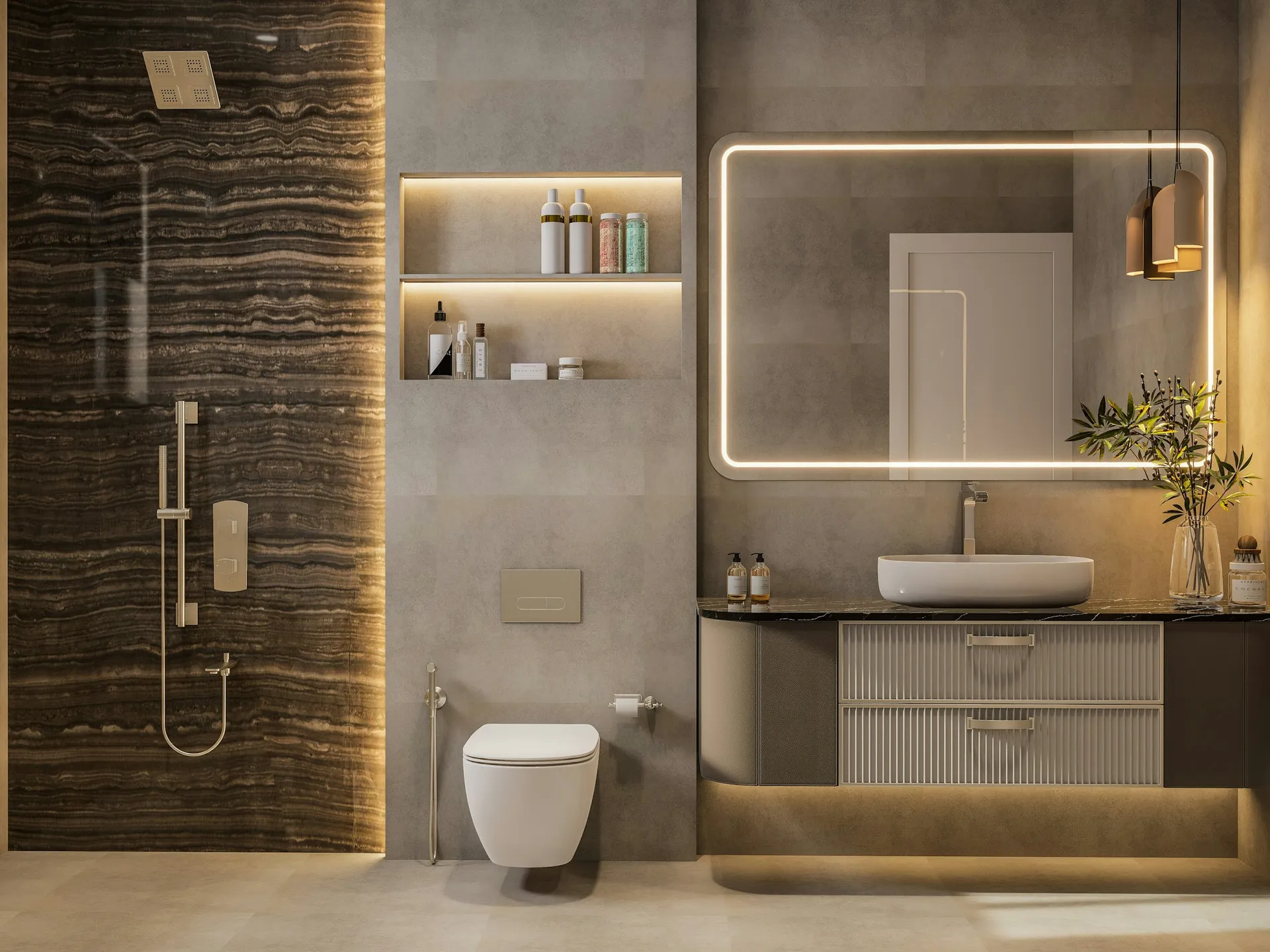
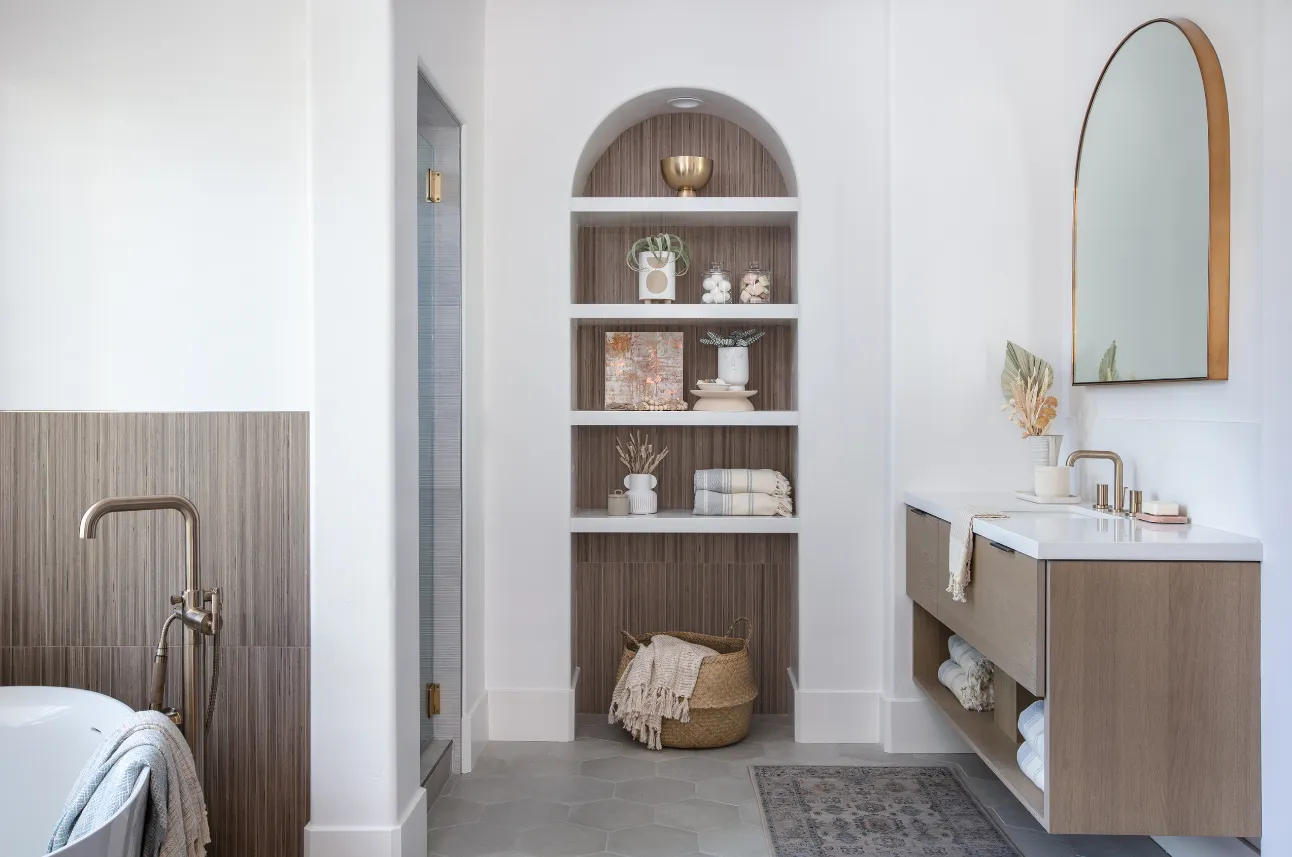
A bathroom vanity is the cabinet, top, basin and mirror (often a mirror cabinet) around your wash basin. In Singapore it works harder than in most places: bathrooms are humid most of the day, the floor gets wet after every shower, and many HDB bathrooms are small enough that the vanity sits right next to the shower area.
That is why the carcass material (the box of the cabinet) matters more than the door finish. A cabinet that swells at the edges will look tired within a few years no matter how nice the laminate was. The usual choices are PVC foam board, aluminium and marine-grade plywood, with ready-made units with an integrated ceramic basin as the simplest option.
On top, you choose between an integrated basin top, solid surface, quartz, sintered stone or natural stone, and then a basin style: undermount, vessel (countertop) or semi-recessed. Finish with a mirror or mirror cabinet, which in a small bathroom is often the most useful storage you have.
Below we compare each option honestly, then cover how to choose, what to ask your carpenter, and the Singapore rules worth knowing. For the tap itself, see kitchen sinks and taps, which explains the water efficiency label that also applies to basin taps.
Bathroom vanities options at a glance
| Option | Cost | Durability | Upkeep | Best for |
|---|---|---|---|---|
| Ready-made vanity with integrated ceramic basin | Budget | good | low | Common bathrooms in BTO and resale flats on a tight budget |
| PVC foam board carcass | Mid-range | good | low | Custom vanities in humid or poorly ventilated bathrooms |
| Marine or BWR plywood carcass with laminate | Mid-range | good | medium | Master bathrooms where a heavy stone top or many drawers are planned |
| Aluminium carcass | Upper | excellent | low | Owners who want the most water-tolerant cabinet, including under-sink areas |
| Open counter or shelf without cabinet | Budget | good | medium | Small common bathrooms and minimalist or Japanese-style homes |
| Solid surface top | Mid-range | good | low | Seamless tops with integrated basins in family bathrooms |
| Quartz top | Upper | excellent | low | Master bathroom vanities with an undermount basin |
| Sintered stone top | Premium | excellent | low | Premium vanities and slim, modern counters |
| Natural stone top (marble or granite) | Premium | good | high | Luxury or classic-style bathrooms where owners accept patina |
| Undermount basin | Mid-range | good | low | Quartz, sintered stone and solid surface tops in daily-use bathrooms |
| Vessel (countertop) basin | Mid-range | good | medium | Feature vanities in master bathrooms and hotel-style designs |
| Mirror cabinet | Mid-range | good | low | Small bathrooms where under-basin storage is limited |
Cost is relative within bathroom vanities ($ budget to $$$$ premium). Actual prices depend on brand, size and workmanship, so compare itemised quotes.
Ready-made vanity with integrated ceramic basin
- Budget Budget
- Durability: good
- Upkeep: low
A factory-made cabinet sold together with a one-piece ceramic basin top. The simplest and usually most affordable way to get a tidy vanity, especially in common bathrooms.
Best for: Common bathrooms in BTO and resale flats on a tight budget
Pros
- One-piece ceramic top has no joints where grime collects
- Quick to install, often within a day
- Easy to replace like-for-like later
- Predictable price, no custom carpentry needed
Cons
- Fixed widths, so gaps either side are common in odd-sized bathrooms
- Carcass quality varies widely between products
- Less counter space than a custom top
- Few colour and texture choices for the basin
Ready-made vanities usually come in standard widths. Home & Decor notes that ceramic wall-hung basins commonly come in fixed widths of about 45cm or 60cm, and ready-made vanities follow similar modules. Before buying, measure the wall between the WC and the shower area, and check where the existing waste pipe and water points sit so the cabinet does not clash with them.
Ask what the carcass is made of. Units sold for bathrooms are often PVC or aluminium, but some use particleboard or MDF, which swell once water gets into a cut or chipped edge. Look underneath and inside the cabinet: exposed raw board edges are a warning sign.
PUB lists installing, replacing or removing a washbasin or sink (including the trap below it) as simple plumbing work that does not need a PUB licensed plumber, so this is one of the easier bathroom upgrades.
PVC foam board carcass
- Mid-range Mid-range
- Durability: good
- Upkeep: low
A custom-built cabinet made from rigid PVC foam board, finished with laminate or a solid PVC colour. Popular in Singapore bathrooms because the board itself does not absorb water.
Best for: Custom vanities in humid or poorly ventilated bathrooms
Pros
- Board does not soak up water, so it will not swell like particleboard
- Easy to wipe clean inside and out
- Can be built to any width or depth
- Mid-range cost for a fully custom cabinet
Cons
- Less rigid than plywood, so long spans can sag without support
- Screws hold less firmly, so hinges can loosen with heavy use
- Laminate on top can still peel if the glue line stays wet
- Quality and density vary between suppliers
PVC foam board is the usual answer when a homeowner asks for a "waterproof" bathroom cabinet. The core is plastic, so water that sits on it will not make it swell. The weak points are the things attached to it: hinges, drawer runners and laminate. Ask your carpenter how hinges are fixed (some use reinforcement blocks or through-fixings), and keep cabinet spans moderate so the top shelf does not bow under toiletries.
For a wall-hung vanity, check how the cabinet is supported. Foam board is light, but a stone top is not, so the frame or wall brackets need to carry the top, not the board alone. Specify edge banding on every exposed edge, even though the core is water-resistant, so the finish looks clean for longer.
Marine or BWR plywood carcass with laminate
- Mid-range Mid-range
- Durability: good
- Upkeep: medium
Plywood bonded with water-resistant glue, faced with laminate. Stronger and holds hardware better than foam board, but the edges must be sealed properly.
Best for: Master bathrooms where a heavy stone top or many drawers are planned
Pros
- Strong and stiff, handles stone tops and long spans
- Holds screws, hinges and drawer runners well
- Wide range of laminate and veneer finishes
- Carpenters work with it every day, so quality is easy to find
Cons
- Still a wood product: raw edges can swell if water gets in
- Relies on careful edge banding and sealing around the basin cut-out
- Not every board sold as marine is true marine grade
- Can harbour mould if a leak goes unnoticed inside the cabinet
Water-resistant plywood comes in grades. Boards described as moisture resistant cope with humidity, while boiling water resistant (BWR) and marine grades use stronger resins for wet conditions. Ask your carpenter which grade is quoted and whether it is written in the quotation.
The failure point is almost always an edge: the cut-out for the basin and waste pipe, the bottom of the side panels near a wet floor, or chipped laminate on the door. Ask for every cut edge to be sealed or edge-banded, for the cabinet to sit off the floor (wall-hung or on legs), and for a sealant bead where the top meets the wall. Check under the basin every few months for drips from the trap or tap hoses.
Aluminium carcass
- Upper Upper
- Durability: excellent
- Upkeep: low
A cabinet frame and body made from aluminium profiles and panels, often powder-coated or with a laminate or glass front. Unaffected by water and termites.
Best for: Owners who want the most water-tolerant cabinet, including under-sink areas
Pros
- Does not swell, rot or attract termites
- Stays dimensionally stable in humidity
- Strong for its weight
- Easy to wipe clean inside
Cons
- Usually costs more than foam board or plywood
- Fewer specialist fabricators than for wood carpentry
- Dents if knocked hard and cannot be sanded out
- Can look utilitarian unless the fronts are well chosen
Aluminium vanities have become a common choice for owners who have had a wood cabinet swell before. The carcass will survive leaks, but check the finish: powder coat quality, how fronts are attached, and whether the hinges and screws are stainless steel or another corrosion-resistant metal. Cheap fixings can rust and stain long before the aluminium itself has a problem.
Ask whether the cabinet is assembled from a supplier system with spare parts available, because replacing a single hinge or panel years later is easier with a standard system than with a one-off build.
Open counter or shelf without cabinet
- Budget Budget
- Durability: good
- Upkeep: medium
A slim wall-mounted counter or open shelf holding the basin, with no closed cabinet below. Keeps the floor clear and suits small or minimalist bathrooms.
Best for: Small common bathrooms and minimalist or Japanese-style homes
Pros
- Floor stays clear and easy to mop
- Makes a small bathroom look larger
- Nothing hidden inside to grow mould
- Usually the lowest-cost custom option
Cons
- Very little closed storage
- Waste pipe and trap are on show
- Items on open shelves need regular tidying
- Needs a mirror cabinet to make up for lost storage
Home & Decor lists a simple wall-mounted counter as a sleek option that does not take up floor area, with storage moved to a mirror cabinet above. It works well for guest and common bathrooms used mainly for washing hands and brushing teeth.
If the trap will be visible, choose a chrome or matching bottle trap rather than a plain plastic one, and ask the plumber to keep the pipework neat and centred. The counter itself can be solid surface, quartz, sintered stone or tiled, as long as the brackets are rated for the weight.
Solid surface top
- Mid-range Mid-range
- Durability: good
- Upkeep: low
An acrylic-based composite top that can be shaped with an integrated basin, giving a seamless, joint-free counter. Repairable and comfortable to the touch.
Best for: Seamless tops with integrated basins in family bathrooms
Pros
- Basin and counter can be formed as one piece with no joint
- Minor scratches can be sanded and polished out
- Non-porous, so it does not stain easily
- Usually the most affordable of the engineered tops
Cons
- Scratches more easily than quartz or sintered stone
- Can be marked by hot styling tools
- Looks less like real stone
- Quality of seams depends on the fabricator
Qanvast lists solid surface as the most affordable of the three common vanity top materials (solid surface, quartz and sintered stone). Its strength in a bathroom is the integrated basin: with no rim or silicone joint between basin and counter, there is nowhere for soap scum and mould to hide.
Keep curling irons and hair straighteners on a heat mat. Ask the fabricator for a sample showing a seam, and how they handle repairs if the top is chipped later.
Quartz top
- Upper Upper
- Durability: excellent
- Upkeep: low
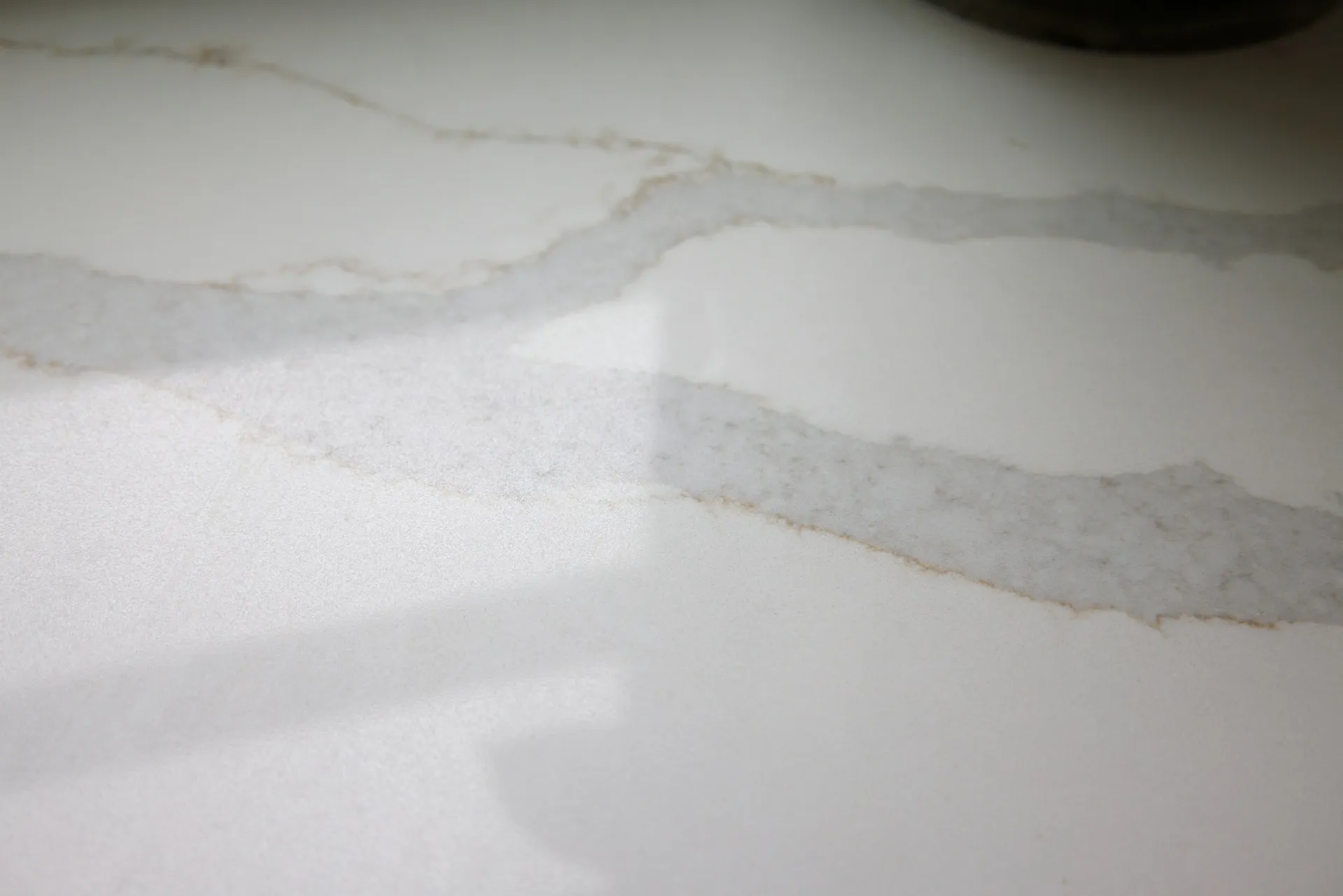
An engineered stone made mostly of crushed quartz bound with resin. Hard, non-porous and available in many stone-look patterns.
Best for: Master bathroom vanities with an undermount basin
Pros
- Hard-wearing and resistant to scratches
- Non-porous, so toiletries do not stain it easily
- Consistent colour across slabs
- Pairs well with undermount basins
Cons
- Costs more than solid surface
- Joints are visible on long counters
- Heavy, so wall-hung cabinets need proper support
- Some colours can be marked by strong chemicals
Quartz is a common upgrade for master bathroom vanities in both HDB flats and condos. Because it is non-porous it does not need sealing, and it cleans easily with mild soap. Avoid harsh cleaners such as strong bleach or solvent-based products left on the surface.
Most bathroom vanities are short enough to be cut from one slab, so joints are rarely an issue. Ask for the basin cut-out edge to be polished and for the top to be fixed with a continuous bead of sealant at the wall. For a comparison with kitchen worktops, see countertops.
Sintered stone top
- Premium Premium
- Durability: excellent
- Upkeep: low
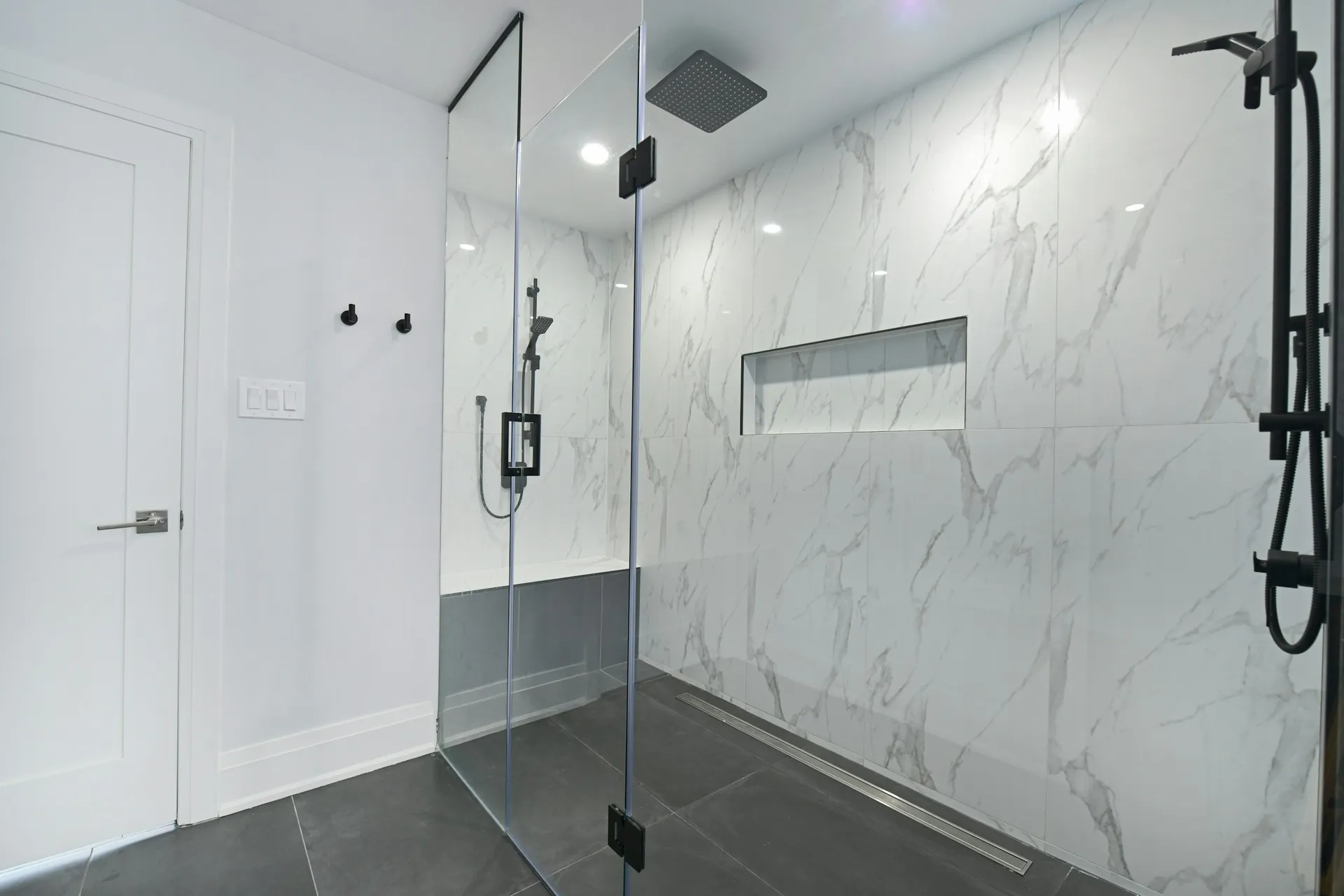
A dense slab made by fusing minerals at high temperature, often in thin formats. Very hard and heat-resistant, with realistic marble and concrete looks.
Best for: Premium vanities and slim, modern counters
Pros
- Very hard and scratch-resistant
- Unaffected by heat from styling tools
- Non-porous and easy to clean
- Thin profiles give a sleek look
Cons
- Usually the priciest of the engineered tops
- Edges can chip if knocked hard
- Needs a skilled fabricator for cut-outs
- Chips are hard to repair invisibly
Qanvast describes sintered stone as the pricey option among vanity tops. In a bathroom its heat resistance is a real benefit if you use hot styling tools on the counter. The main risk is chipping on the edge or around the basin cut-out, so choose a slightly rounded or eased edge rather than a sharp square one, and confirm the fabricator has done bathroom cut-outs in the same thickness before.
Natural stone top (marble or granite)
- Premium Premium
- Durability: good
- Upkeep: high
A slab of quarried stone. Each piece is unique, but most natural stone is porous to some degree and needs sealing in a wet area.
Best for: Luxury or classic-style bathrooms where owners accept patina
Pros
- Every slab is unique
- Marble suits classic, luxury and colonial styles
- Granite is hard and hard-wearing
- Can be honed or polished
Cons
- Porous: needs sealing and can stain
- Marble etches with acidic products
- Heavy, needs strong support
- Costly to replace or repair
Natural stone is beautiful but asks for more care than engineered tops. Marble reacts with acids (some cleaners, toothpaste residue left for long periods and certain cosmetics), leaving dull marks. Ask your supplier how often the stone should be resealed and with what. In a busy family bathroom, quartz or sintered stone in a marble look gives a similar feel with far less upkeep.
Undermount basin
- Mid-range Mid-range
- Durability: good
- Upkeep: low
A basin fixed beneath a cut-out in the counter, so the top runs straight into the bowl. Lets you wipe water and toothpaste straight into the basin.
Best for: Quartz, sintered stone and solid surface tops in daily-use bathrooms
Pros
- Easy to wipe the counter straight into the basin
- Clean, seamless look
- Lower basin rim suits young children
- Frees up usable counter space
Cons
- Needs a solid, non-porous top with a polished cut-out
- Join under the rim must be sealed well to avoid grime
- Harder to replace than a sit-on basin
- Not suitable for laminate tops
Qanvast notes that undermount basins give a seamless look and are easier for young children to reach. Home & Decor describes under-counter basins as a good choice if you want more vanity and counter space. Ask how the basin is supported (clips and adhesive, or a frame) and check the seal under the rim during handover, because that hidden joint is where grime builds up over time.
Vessel (countertop) basin
- Mid-range Mid-range
- Durability: good
- Upkeep: medium
A bowl that sits on top of the counter. Strong visual feature, available in ceramic, stone, solid surface and other materials.
Best for: Feature vanities in master bathrooms and hotel-style designs
Pros
- Huge range of shapes and materials
- Easy to install on a strong, flat counter
- Counter material does not need a polished cut-out
- Makes a strong design statement
Cons
- Raised rim means splashes land on the counter
- Gap between bowl and counter needs cleaning
- Needs a taller tap or wall-mounted tap
- Higher rim can be awkward for children
Home & Decor notes that countertop basins are usually more costly but easy to install, as long as the counter is sturdy. Plan the tap at the same time: a vessel basin needs either a tall basin mixer or a wall-mounted tap. Home & Decor also points out that in HDB flats, a wall-mounted tap may need a false wall of about 20 to 30cm to hide the pipes, which takes space from a small bathroom.
Check the overall height. With a vessel basin, the rim height is the counter height plus the bowl height, so lower the counter to keep the rim comfortable.
Mirror cabinet
- Mid-range Mid-range
- Durability: good
- Upkeep: low
A cabinet with mirrored doors above the basin. In small Singapore bathrooms it is often the most useful storage, and can include lighting and a demister.
Best for: Small bathrooms where under-basin storage is limited
Pros
- Adds storage without using floor space
- Keeps toiletries off the counter
- Can include LED lighting and an anti-fog pad
- Works with wall-hung or open counters
Cons
- Lighted or demister versions need a power point
- Mirror edges can corrode if water sits on them
- Hinges loosen over time in a humid room
- Deep cabinets can feel bulky above a small basin
A mirror cabinet is the easiest way to recover storage if you choose an open counter or a slim wall-hung vanity. If you want built-in lighting or a demister, plan the power point early, because electrical work must be done by an EMA licensed electrical worker and is far easier before the tiles and vanity go in.
Choose a cabinet with sealed or protected mirror edges and corrosion-resistant hinges. Mount it so the bottom edge clears a tall tap, and so the shelves sit at eye level for the main users.
How to choose a bathroom vanity
Start with the room, not the catalogue. Measure the wall between the WC and the shower zone, note where the waste pipe and water points are, and decide how much storage you really need. Then work through four decisions in order:
- Wall-hung or floor-standing. In most Singapore bathrooms, wall-hung is the better choice. The floor underneath stays dry and easy to mop, and the cabinet base is never sitting in water. Floor-standing vanities hold more and are simpler to fix, but choose one on legs or with a raised plinth so the bottom panel is not in contact with a wet floor.
- Carcass material. PVC foam board and aluminium tolerate water best. Marine or BWR plywood is stronger and holds hardware better, but relies on sealed edges. Avoid standard particleboard or MDF in a bathroom.
- Top material. Solid surface for a seamless integrated basin at moderate cost, quartz for durability, sintered stone for a premium look and heat resistance, natural stone only if you accept extra care.
- Basin style. Undermount for easy cleaning, vessel for a feature look, semi-recessed (where only the front of the basin projects past the cabinet) for shallow cabinets in narrow bathrooms, or an integrated ceramic basin top for the simplest result.
Sizes and heights to check
- Counter height: Home & Decor suggests a basin height of around 85 to 90cm from the floor to the top of the sink. With a vessel basin, lower the counter so the rim lands in that range.
- Depth: In narrow HDB common bathrooms, a shallow cabinet with a semi-recessed basin keeps the walkway clear.
- Clearance: Leave enough space beside the WC and in front of the vanity to move comfortably. Corner basins suit tiny bathrooms, but keep them far enough from the wall that you do not knock elbows.
- Mirror: Hang it so the bottom edge clears your tap and the centre is at eye level for the main users.
What to ask your carpenter or supplier
- What exactly is the carcass made of, and is the grade written in the quotation?
- Are all cut edges sealed or edge-banded, including the basin cut-out?
- How is a wall-hung cabinet fixed, and is the bracket or frame rated for the top you chose?
- Are the hinges and drawer runners soft-close and corrosion-resistant?
- Who seals the top to the wall, and with what?
- Does the price include the basin, tap, bottle trap and installation?
Writing these answers into the quotation lets you compare like with like. Our guide to comparing renovation quotations explains how.
Singapore rules and climate
- New BTO flats: HDB applies a 3-year restriction on removing wall and floor finishes in bathrooms and toilets of newly built flats. A wall-hung vanity is still possible, but fixings go through the tiles, so ask your contractor to drill carefully and seal each hole. Avoid designs that need tiles hacked (such as concealed wall pipes for a wall-mounted tap) until the restriction ends.
- Plumbing: PUB lists installing, replacing or removing a washbasin or sink, including the trap below it, as simple plumbing work that does not need a PUB licensed plumber. Changes to water supply pipes are a different matter and need a licensed plumber.
- Taps: basin taps and mixers are under PUB's mandatory Water Efficiency Labelling Scheme. PUB's rating table states that from 1 April 2019 only 2-tick and above fittings may be supplied and installed. A 2-tick basin tap flows at more than 2 and up to 4 litres a minute, and a 3-tick tap at 2 litres or less.
- Humidity: bathrooms in Singapore rarely dry out fully. Run the exhaust fan or keep the window open after showers, and leave cabinet doors open occasionally to air the inside.
Common mistakes
- Choosing a cabinet on looks and finding out later it is particleboard.
- Letting a floor-standing cabinet sit directly on a wet floor.
- Pairing a vessel basin with a standard-height counter, so the rim ends up too high.
- Skipping the mirror cabinet in a small bathroom, then cluttering the counter.
- Forgetting a power point for a lighted mirror or electric toothbrush until after tiling.
How it affects your budget
The carcass and top drive cost. Ready-made units with an integrated ceramic basin are the budget route; custom foam board or plywood sits in the middle; aluminium carcasses and quartz or sintered stone tops push the price up. Qanvast puts basic bathroom renovation works at roughly $3,000 to $3,200 per bathroom in its 2024 guide (an indicative estimate), with fittings budgeted separately, so the vanity is one of the larger choices within that fittings budget.
How JIAHOME can help
We plan the whole bathroom first, including vanity dimensions, basin type and mirror storage, and list every item in a quotation without prices, so any contractor can price the same scope. See our services or book a free consultation.